Migrations & Cloud Foundations
Bringing Your Own AI Agent to Amazon Connect Customer: An Open-source Accelerator for Agent-to-Agent Collaboration
Amazon Connect Customer's agent-to-agent support now lets you bring Google and OpenAI voice models to your contact center. Learn why model choice matters, how the open-source strands-connect SDK makes it practical, and how to approach it with a real customer.

On this page
Every contact center leader eventually lands on the same question about AI: which model should be on the other end of the call? For a long time, the path of least resistance in Amazon Connect Customer has run through Amazon's own models, with Amazon Nova Sonic the natural choice for voice. That was a sensible default, but it is no longer the boundary. Amazon Connect Customer's agent-to-agent (A2A) voice support lets an external agent handle the call audio, so real-time models from Google and OpenAI can now sit behind an Amazon Connect Customer call, and Caylent has published an open-source SDK, strands-connect, to make that practical.
In this blog, we’ll share why that matters, what has to be true around it for it to be safe, and how to approach it with a real customer.
Note: In 2026, AWS began calling the contact center product Amazon Connect Customer, as part of an Amazon Connect Customer family that also includes Decisions, Talent, and Health. Contact Lens is now called Conversational Analytics, and Amazon Q in Connect is now called agent assist. This post uses "Amazon Connect Customer" and "Connect Customer" for the contact center product.
Why Model Choice Matters More Here Than Almost Anywhere
In most enterprise AI work, a mediocre model choice shows up as a slightly worse answer. In a contact center, it shows up as dead air on a phone call, a mispronounced name, or an assistant that cheerfully refunds the wrong order. The constraints are unusually tight:
- Latency. Voice conversations tolerate almost no silence. A brilliant but slow model is the wrong model.
- Language coverage. Your customers do not all speak the language your pilot was tested in.
- Cost at volume. A fraction of a cent per turn is trivia in a demo and a line item at ten million contacts. The Amazon Connect Customer Unlimited AI pricing model charges a flat, premium rate per chat message or voice minute, regardless of the model used by your Amazon Connect Customer AI Agent. The intention is to simplify pricing so customers don’t have to account for turns or tokens.
- With A2A, you pay the Unlimited AI usage fee *plus* the cost of the external model. The Unlimited AI rate itself remains the same regardless of which external model you choose.
- Behavior. Some models follow a strict policy more faithfully; others handle ambiguity better. Different journeys need different strengths.
No single model wins on all four, and the leaderboard changes monthly. Locking a contact center to one model family means living with its weaknesses or rebuilding when something better arrives. Four decades of building software teach that the components you can swap are the ones that survive. Model choice makes the model a replaceable part, which is exactly what it should be.
The Platform Around the Model Has Matured
Flexibility only helps if you can tell whether a change improved things. That is where Amazon Connect Customer’s last twelve months matter:
- Control where it counts. Agentic CX designer reached general availability in September. It is a no-code canvas that pairs open-ended conversation with deterministic steps for the moments that must go exactly right, such as authentication, verification, and required disclosures.
- Agents working together. Agent-to-agent collaboration, announced on September 22, 2026, lets Amazon Connect Customer AI agents collaborate with each other, and with agents outside Amazon Connect Customer, over the open A2A protocol. It requires the Amazon Connect Customer tier rather than Customer Basic, is configured through the API only, and needs a Lex V2 bot for voice contacts.
- Evidence. AI agent trace details for self-service voice, new metrics such as goal success rate, faithfulness score, and tool selection accuracy, and generative AI evaluation of self-service interactions give you a way to measure what a model is actually doing on real calls.
Taken together, these capabilities set Amazon Connect Customer apart from other contact center platforms. Many services let you plug in an AI model. Far fewer pair that choice with deterministic controls for authentication and disclosures, open-protocol collaboration with agents outside the platform, and built-in measurement of how the model behaves on real calls. Because the model, the guardrails, and the evidence live in one platform, you can adopt a better model when one arrives without rebuilding your controls or losing your baseline. For organizations that need to move quickly on AI without giving up governance, that combination makes Amazon Connect Customer the strongest choice among comparable services.
What Strands-connect Brings
Strands Agents is AWS's open-source agent SDK, and it already supports a range of model providers. Strands-connect, Caylent's open-source extension, applies that flexibility to Amazon Connect Customer voice: bring your own real-time voice model, system prompt, and business tools, and the library handles the Amazon Connect Customer plumbing.
Here is how a call flows:
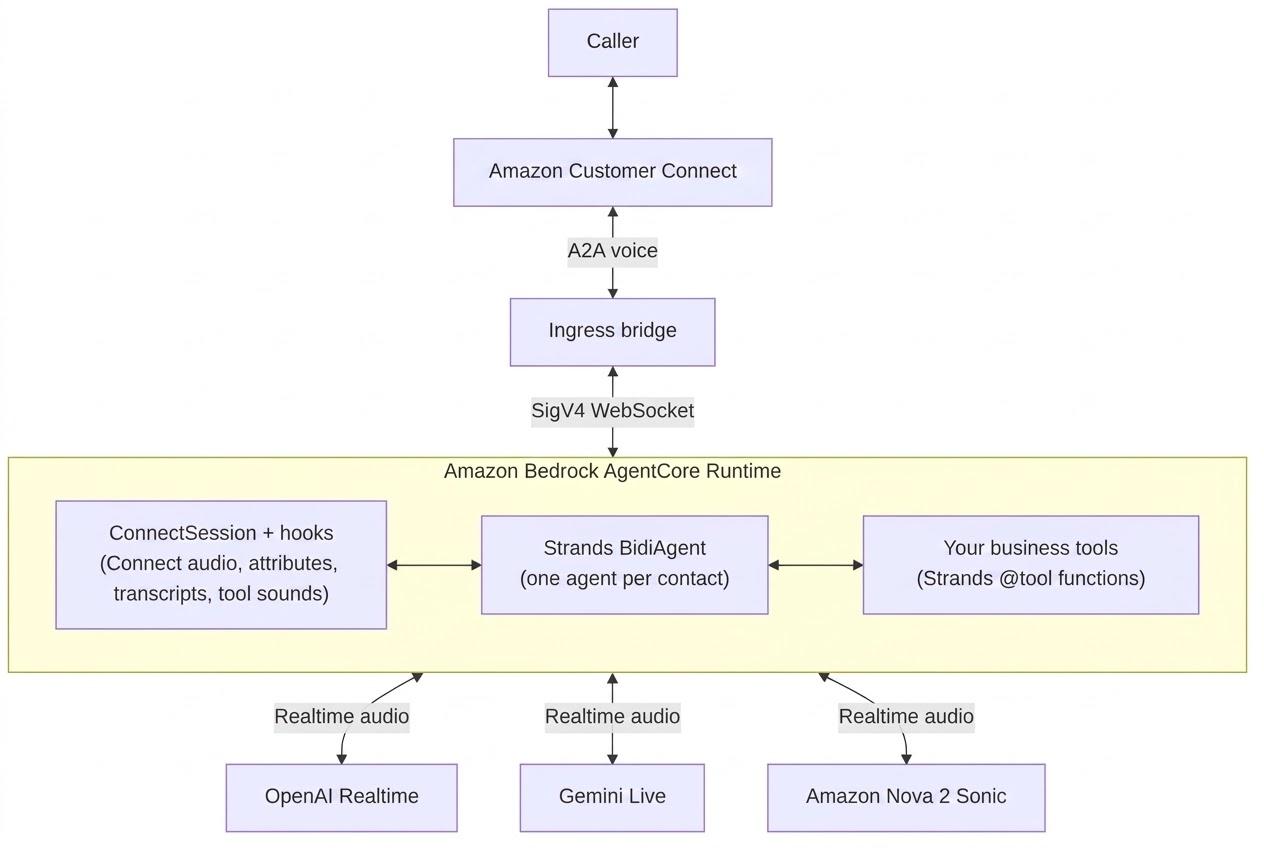
Audio flows both ways through every link. The adapter also writes contact attributes, transcripts, and tool traces back to Amazon Connect Customer, and the voice model is the one part you swap.
Most of what makes it usable is mundane. When a tool returns, the library saves the mapped result to Amazon Connect Customer contact attributes and reads it back before the model sees it, so a failed save surfaces as an error instead of a silent gap. A soft pulse plays while tools run, so callers hear that something is happening rather than silence. Transcripts and handback to Amazon Connect Customer are handled too.
Three runnable examples ship with the repository, one per provider, all running the same synthetic order-lookup scenario on AgentCore. OpenAI and Gemini authenticate with provider API keys; Nova 2 Sonic uses AWS IAM.
A word of caution: this is early work. The repository is at version 0.2.4, describes itself as an independent community extension rather than an AWS, Strands, OpenAI, or Google product, and notes that the real-time Strands API is experimental, so tested versions are pinned.
It is Apache 2.0 licensed and installs directly from GitHub for now, at github.com/caylent/strands-connect. Treat it as a strong starting point to try, fork, and extend, not a finished product.
How to Approach it with a Customer
A few principles worth applying on day one:
- Start with the evaluation, not the model. Define success for each journey first, whether that is goal success rate, faithfulness, containment, or handle time. A model is only "better" against a measure you chose in advance.
- Pick a narrow journey. Order status, appointment rescheduling, and password resets make good first candidates: high volume, clear outcomes, low blast radius. If you start with everything you are very likely to spread yourself too thin to do anything well.
- Test candidates side by side. Replay the same scenarios against each model using Amazon Connect Customer's testing and simulation, then compare results rather than impressions.
- Keep deterministic things deterministic. Identity checks, payments, and regulatory disclosures belong in explicit flow steps, not in a model's judgment.
- Be deliberate about data. With OpenAI or Gemini behind the call, live audio goes to that provider under its own API key and terms, outside the boundary you are used to. Bring security and privacy teams in early, and use redaction before content travels.
- Plan for the next swap. Version your prompts, keep your evaluation sets, and assume today's pick is temporary.
What This Does Not Change
Model choice does not remove the hard parts of a contact center project. Answers are only as good as the knowledge behind them. The agent can only do what its integrations allow, and when a frustrated customer needs a person, escalation design determines how fast that person arrives, and whether they arrive knowing the story.
A better model on top of a weak foundation is a faster way to disappoint people. If anything, the added flexibility raises the premium on the fundamentals, because you now have more ways to vary results and need to know which variable you changed.
Why This Matters
A conversation is, at its core, a theory-of-mind problem. To help someone, you have to model what they know, what they want, and what they are not saying. Different models do that differently, and different customers, languages, and moments call for different strengths. The organizations that do well with AI in customer experience will not be the ones that pick the right model once. They will be the ones that build the discipline to keep choosing.
Amazon Connect Customer has moved from "here is the model" to "here is the platform, bring the model that fits." It makes the decision harder in one sense, and far more yours in every sense that counts.
How Caylent Can Help
Ready to build an AI-native customer experience on Amazon Connect Customer? Caylent’s Customer Experience Transformation practice helps enterprises migrate from legacy contact center platforms and expand their capabilities with AI-powered self-service, omnichannel engagement and intelligent automation. With Amazon Connect Customer experience dating back to its launch in 2017 and deployments ranging from 12 to more than 10,000 agents, our team helps you evaluate model choices, integrate business systems, and turn AI flexibility into measurable customer outcomes. Connect with Caylent to get started.
Share