 Caylent Team
Caylent Catalysts™
Disaster Recovery Strategy
Determine the disaster recovery (DR) strategy best suited to protect your workloads on AWS, tailored to your budgets and recovery targets.
Explore how ACGR in CxPortal extends Amazon Connect Global Resiliency by giving contact center operations teams a centralized, playbook-driven way to execute, manage, and monitor regional failover and recovery, reducing downtime and accelerating response during service disruptions.
Regional failover in Amazon Connect is an infrastructure capability, but a regional disruption is felt immediately on the contact center floor. Calls drop, contacts route incorrectly, and agents lose the ability to log in. Downtime carries consequences that directly impact customer interactions, SLA commitments, executive visibility, and brand trust.
Amazon Connect Global Resiliency (ACGR) provides the foundation for multi-region redundancy through traffic distribution groups that manage agent and telephony failover. However, infrastructure capability alone does not ensure operational readiness.
Today, initiating failover requires access to the AWS Management Console or CLI. In many organizations, access resides with infrastructure or cloud engineering teams rather than contact center operations. As a result, the team that detects the disruption is often not the team authorized to execute failover.
This separation introduces delay at the very moment speed matters most.
ACGR in CxPortal closes this operational gap by placing failover execution directly in the hands of contact center operations. As a result, resiliency shifts from an engineering procedure to an embedded operational capability.
ACGR in CxPortal builds on the underlying Amazon Connect Global Resiliency framework by introducing an operational control layer designed for contact center teams. Instead of managing resiliency across multiple AWS interfaces, organizations can centralize configuration, execution, and visibility within a single operational environment.
This environment brings together playbook configuration, traffic distribution management, and real-time regional visibility.
With ACGR in CxPortal, resiliency becomes structured, governed, and repeatable.
ACGR in CxPortal operationalizes resiliency across three phases: preparation before an incident, execution during an incident, and controlled recovery after.
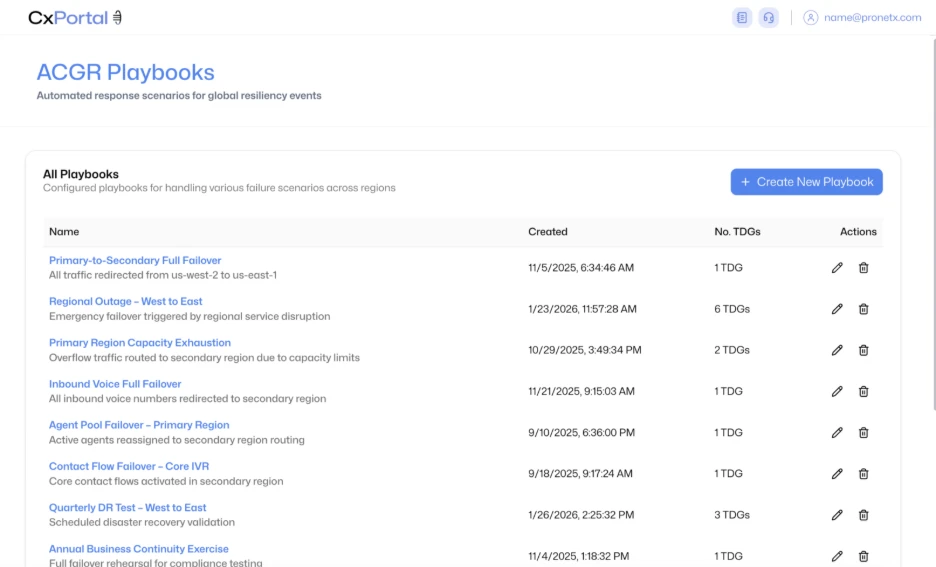
Before an incident occurs, disruption scenarios are formalized as playbooks that define how traffic should redistribute across regions. Agents and phone numbers are organized into traffic distribution groups, with primary and secondary routing paths established in advance.
Each playbook is validated during planned maintenance windows to confirm expected behavior. As a result, failover execution follows a controlled and repeatable process rather than an improvised response under pressure.
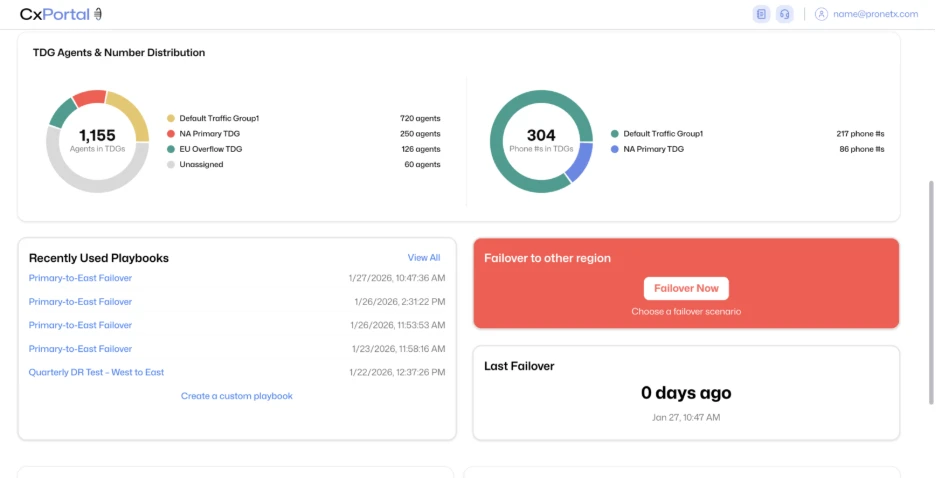
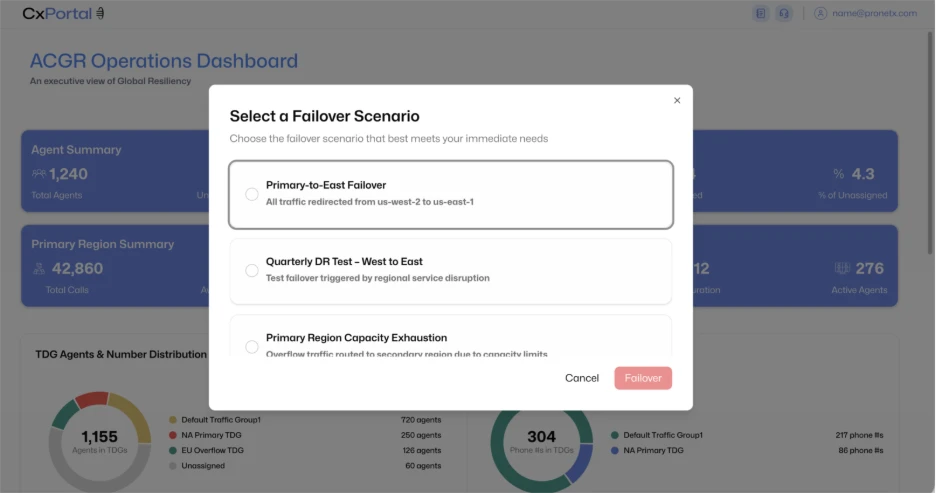
During a regional impairment, health status is monitored directly within CxPortal. When action is required, the appropriate playbook is selected, scope is reviewed, and execution is confirmed.
Traffic shifts automatically to the designated backup region without manual reconfiguration across systems or cross-team escalation. What might otherwise require hours of coordination can be executed within minutes as part of the operational workflow.
Once stability is restored, traffic returns to the primary region in controlled stages. Distribution percentages can be adjusted gradually while monitoring queue performance and agent availability, reducing the risk of overloading the restored region.
Execution history and activity timelines are reviewed to refine playbooks and strengthen future response readiness.
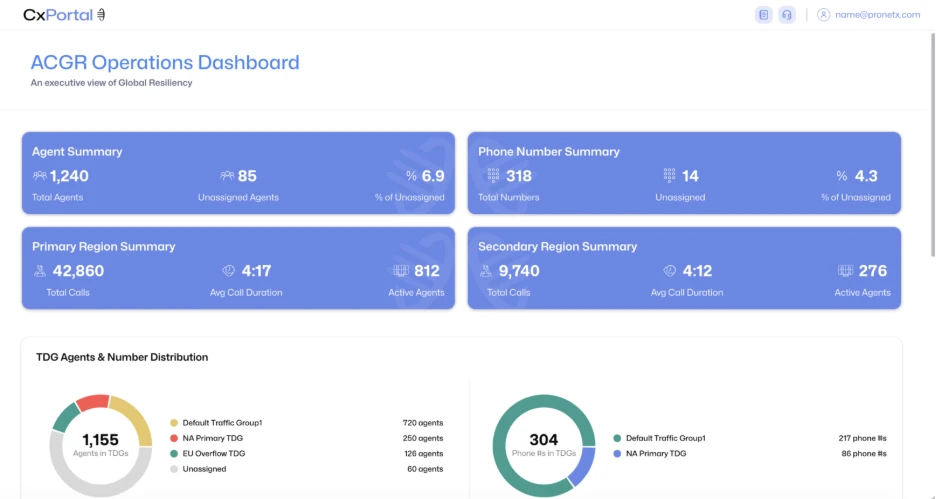
Throughout the event lifecycle, CxPortal provides visibility into:
This level of visibility gives teams a clear record of what occurred, when it occurred, and how traffic was redistributed. It provides clarity during incidents and accountability afterward.
Service continuity. Traffic routes to backup regions based on predefined playbooks, limiting exposure during regional impairments.
Faster recovery time. What might otherwise require hours of coordination can be executed within minutes, reducing the duration and impact of service disruption.
Predictable execution. Failover procedures are configured, tested, and validated before an event occurs, so teams follow a known path during a disruption.
Reduced coordination overhead. The team with real-time operational context executes directly, without escalation paths or cross-team dependencies.
Consistent customer experience. Customers and agents experience continuity without visible disruption, dropped contacts, or degraded routing.

Caylent Catalysts™
Determine the disaster recovery (DR) strategy best suited to protect your workloads on AWS, tailored to your budgets and recovery targets.
Caylent Services
Innovate at the speed of light with modern applications powered by modular architectures running on purpose-built AWS services.

Discover how Kiro is redefining developer productivity - featuring a real-world migration of a .NET Framework application to .NET 8 that transforms weeks of manual effort into just hours with AI-powered automation.
Learn best practices for building resilient IT systems on AWS to ensure reliability, security, and high availability in the face of failures and disruptions.
Explore security best practices for Amazon Elastic Kubernetes Service (EKS) to help maintain a strong security posture.
