 Guille Ojeda
Caylent Catalysts™
Generative AI Strategy
Accelerate your generative AI initiatives with ideation sessions for use case prioritization, foundation model selection, and an assessment of your data landscape and organizational readiness.
Explore what’s new in Claude Sonnet 5.5, including its improvements, where it fits alongside other Claude models, and what organizations should know before migrating.
On September 28, 2026, Anthropic released Claude Sonnet 5.5, bringing substantially stronger performance in coding and professional work to the Sonnet tier as it catches up with the newest generation of Claude models, which started with Opus 5.5. Sonnet 5.5 retains Sonnet 5's standard Claude API rates of $2 per million input tokens and $10 per million output tokens, with lower token consumption and faster output generation reported by Anthropic.
Sonnet 5.5 is an excellent fit for work with a clear objective, such as fixing a bug or producing a spreadsheet analysis. It offers a clear cost advantage over Opus 5.5 at lower efforts, and at maximum effort it approaches the level of Opus on several evaluations. Opus is still stronger for complex, open-ended work requiring sustained judgment. The model is available through Claude and across cloud platforms such as Amazon Bedrock.
In this blog, we will look at what improved, where Sonnet fits alongside the other Claude models, and which changes matter when you move an existing application to Sonnet 5.5.
Sonnet 5.5's coding gains show up in both repository issue resolution and tasks drawn from real development sessions. SWE-bench Pro asks an agent to resolve software-engineering issues, often involving changes across multiple files. CursorBench 4.0 uses tasks from real Cursor sessions and runs them through Cursor's production agent system.
The reported results show a substantial improvement over Sonnet 5:
Sonnet gains 18.1 percentage points on SWE-bench Pro and 21.4 on CursorBench. These results use maximum effort, which lets the model spend more tokens reasoning through the task. Anthropic's system card documents the configurations and methods used.
This makes Sonnet 5.5 a good default for bug fixes, bounded feature changes, and fast iteration. Suppose you have a reproducible bug, a repository, and a clear description of the expected behavior. The model has a defined problem to investigate and an outcome to work toward. The results shown above on repository and development-session tasks are directly relevant to that work.
An assignment that requires deciding what to build, resolving conflicting requirements, and maintaining judgment over a long investigation asks for something more. Anthropic still favors Opus 5.5 for that kind of open-ended work. Sonnet 5.5's improved scores give us a stronger everyday coding option than we previously had with Sonnet 5.
The improvement extends to work whose output is a document, spreadsheet, presentation, or analysis. At maximum effort, Sonnet 5.5 scores 1,839 on GDPval-AA, up from Sonnet 5's 1,465 and just below Opus 5.5's 1,866. This evaluation covers professional tasks across 44 occupations and 9 industries. Outputs are compared against one another, producing an Elo rating: a relative measure of how the submitted work fares, rather than a percentage of tasks completed successfully.
AA-Briefcase tests longer knowledge-work projects involving linked tasks and large collections of source files. At maximum effort, Sonnet 5.5 scores 1,823 Elo, compared with 1,358 for Sonnet 5 and 1,807 for Opus 5.5. The close results appear in both individual professional tasks and longer projects. Artificial Analysis independently ran both evaluations, and Anthropic publishes the results and conditions in its system card.
Sonnet 5.5 retains Sonnet 5's prices and standard limits. Here are the standard Claude API rates in USD per million tokens, using global routing:
Sonnet 5.5 also uses the same tokenizer as Sonnet 5, so the same text produces the same token count. Anthropic reports up to 30% lower task cost in its testing, due to Sonnet 5.5 requiring fewer output tokens per task.
Anthropic separately reports 30%+ faster output generation. Keep in mind that workflows also spend time reasoning and waiting for tools, so faster generation doesn't translate directly into an equal reduction in completion time.
Sonnet's base input/output rates are half of Opus’ and one-fifth of Fable's. Reusing cached prompt content, however, costs the same on Sonnet and Opus. Also, higher effort typically consumes more tokens: Anthropic's cost curves show that Sonnet can approach Opus's performance at a similar task cost at higher settings.
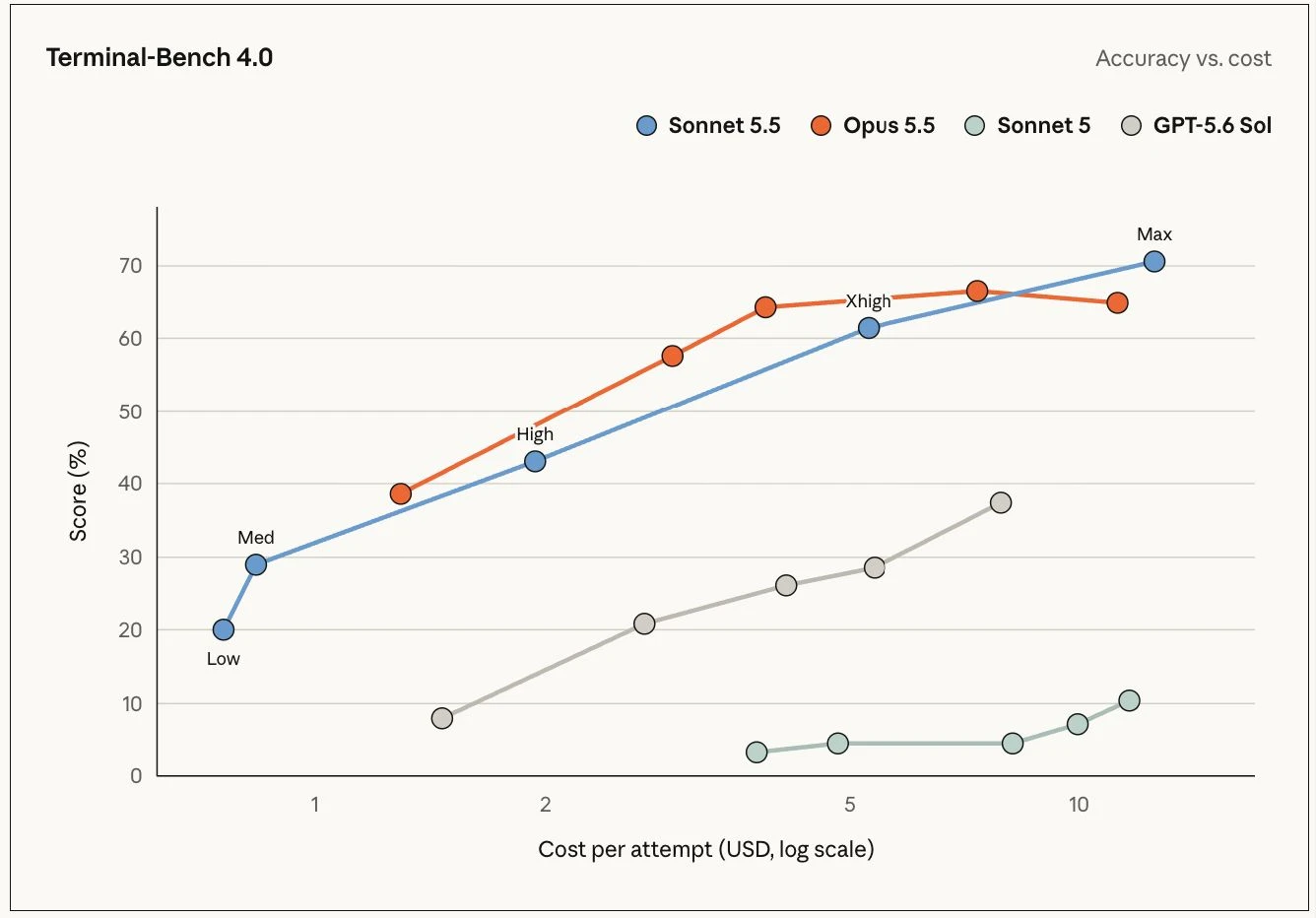
For well-specified agentic coding, Anthropic recommends starting at medium effort. Claude apps and Claude Code default to medium effort, while the API defaults to high. If Sonnet produces the work you need at a lower effort, that's where it's significantly cheaper than Opus.
The Claude API model ID is claude-sonnet-5-5. Changing that ID isn't enough, there are two things you should pay attention to, per Anthropic's migration guide:
thinking: {"type":"disabled"} now returns HTTP 400. If you want to keep thinking disabled, use {"type":"between_tools"} at low, medium, or high effort instead. This keeps up-front thinking off but allows thinking between tool calls. Without tools, responses contain text only. The mode rejects xhigh/max and additional fields such as display, budget_tokens, or block_binding.tool_choice with a value of any or tool now returns 400. Use auto with instructions specifying when to call the tool. Where supported, strict schemas constrain tool arguments, but don't force a call: the model can still answer in text. Bedrock doesn't support structured outputs or strict tool use for Sonnet 5.5, so its documented path uses auto, instructions, and application-side argument validation.Adaptive thinking remains the default, like in Sonnet 5. The other significant change concerns how thinking blocks are preserved across the conversation. Suppose your application edits an earlier system instruction, then sends the conversation back with a thinking block generated after that instruction. Sonnet 5.5 automatically ties a thinking block to the preceding system prompt, tools, and messages. Once you change that history, the block no longer matches. On the Claude API and Bedrock, this returns 400 by default for accounts created on or after August 31, 2026, at 00:00 UTC, while older accounts can opt into enforcement.
The solution is to keep history append-only, using supported mid-conversation instruction or tool changes when needed. The documentation also provides an adaptive-thinking beta control for dropping invalid blocks instead of rejecting the request.
Model and account switches behave differently. Sonnet 5.5 can read Sonnet 5's thinking blocks, but no other model can read Sonnet 5.5's. Its blocks also belong to the producing account or an account Anthropic identifies as linked. When you switch to an incompatible model or unrelated account, the API drops those blocks while the request succeeds. This only affects preserved thinking state, not the ability to transfer visible conversation text.
There's also a visible response change. Longer notes between tool calls now arrive in thinking blocks. Your interface can appear silent while requests continue successfully. With adaptive thinking, thinking.display: "summarized" returns displayable content, and between_tools returns progress notes without that setting.
Sonnet 5.5's greater cybersecurity capability comes with stronger cyber safeguards, similar to those on Opus 5.5. Routine software development remains an intended use. In practice, this means that authorized source-code vulnerability discovery is supported, while vulnerability discovery in compiled binaries is blocked. Some legitimate dual-use security work can also trigger a refusal. Anthropic describes the controls in the system card's cyber-safeguard assessment.
Biology safeguards remain at the Sonnet 5 level, rather than adopting Opus 5.5's broader dual-use biology controls. Most research, education, and clinical work is intended to remain unaffected, although some microbiology and virology requests can be flagged in error.
Sonnet 5.5 is also the first Sonnet with a classifier targeting extraction of hidden reasoning. Asking for an ordinary explanation of an answer is distinct from extracting that internal reasoning. A separate, narrow frontier_llm classifier covers advanced model-development capabilities, though ordinary AI and ML development is intended to remain unaffected.
For cyber and frontier-LLM refusals, first-party apps fall back to Sonnet 5. Claude API developers must opt into fallback, and server-side fallback isn't available on Bedrock. Biology and reasoning-extraction refusals have no fallback. A refusal can return HTTP 200 with stop_reason: "refusal", so it is different from the invalid requests described above.
Sonnet 5.5 is a strong starting point for defined coding tasks and professional deliverables. It improves substantially over Sonnet 5 at the same token rates, and its clearest economic advantage over Opus comes when lower effort produces the work you need. At higher effort, you should compare the cost per completed task with Opus rather than assuming Sonnet is immediately cheaper. Opus is still the stronger recommendation for sustained, open-ended judgment.
For an existing Sonnet application, first address the API changes that affect your requests, then compare representative tasks for acceptable output, completed-task cost, and elapsed time. That establishes what your application actually stands to gain, which hopefully matches the reported capabilities.
As a Preferred Services Partner and Charter Member of the Claude Partner Network, Caylent helps you select and implement Claude models for your applications. Our Anthropic Consulting & Engineering practice supports adoption, enablement, and building agentic applications, including the workload evaluation and cost optimization needed to make a model upgrade useful in production. Whether you're upgrading an existing Sonnet integration or choosing a model for a new application, connect with us to connect the model's capabilities to the work you need it to do.
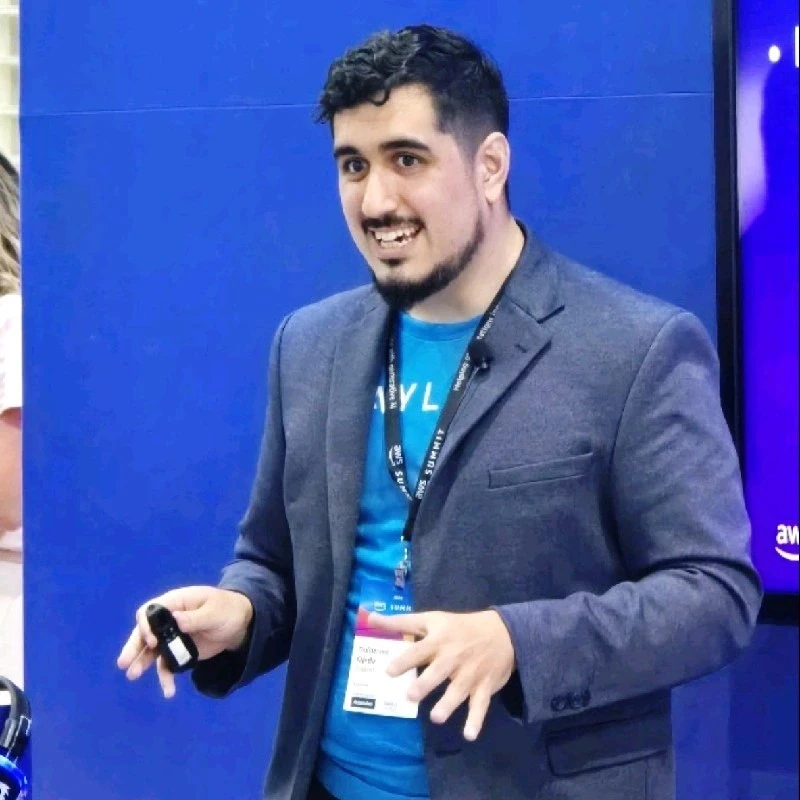
Guille Ojeda is a Principal Innovation Architect at Caylent, a speaker, author, and content creator. He has published 2 books, over 200 blog articles, and writes a free newsletter called Simple AWS with more than 45,000 subscribers. He's spoken at multiple AWS Summits and other events, and was recognized as AWS Builder of the Year in 2025.
View Guille's articlesCaylent Catalysts™
Accelerate your generative AI initiatives with ideation sessions for use case prioritization, foundation model selection, and an assessment of your data landscape and organizational readiness.
Caylent Catalysts™
Accelerate investment and mitigate risk when developing generative AI solutions.
Leveraging our accelerators and technical experience
Browse GenAI Offerings
Explore what’s new in Claude Opus 5.5, from stronger coding and knowledge-work performance to lower pricing, updated API behavior, and broader safeguards.
