Guille Ojeda
Caylent Catalysts™
Generative AI Strategy
Accelerate your generative AI initiatives with ideation sessions for use case prioritization, foundation model selection, and an assessment of your data landscape and organizational readiness.
Explore what’s new in Claude Fable 5.1, how it compares to Fable 5, and what organizations should validate before migrating their workloads.
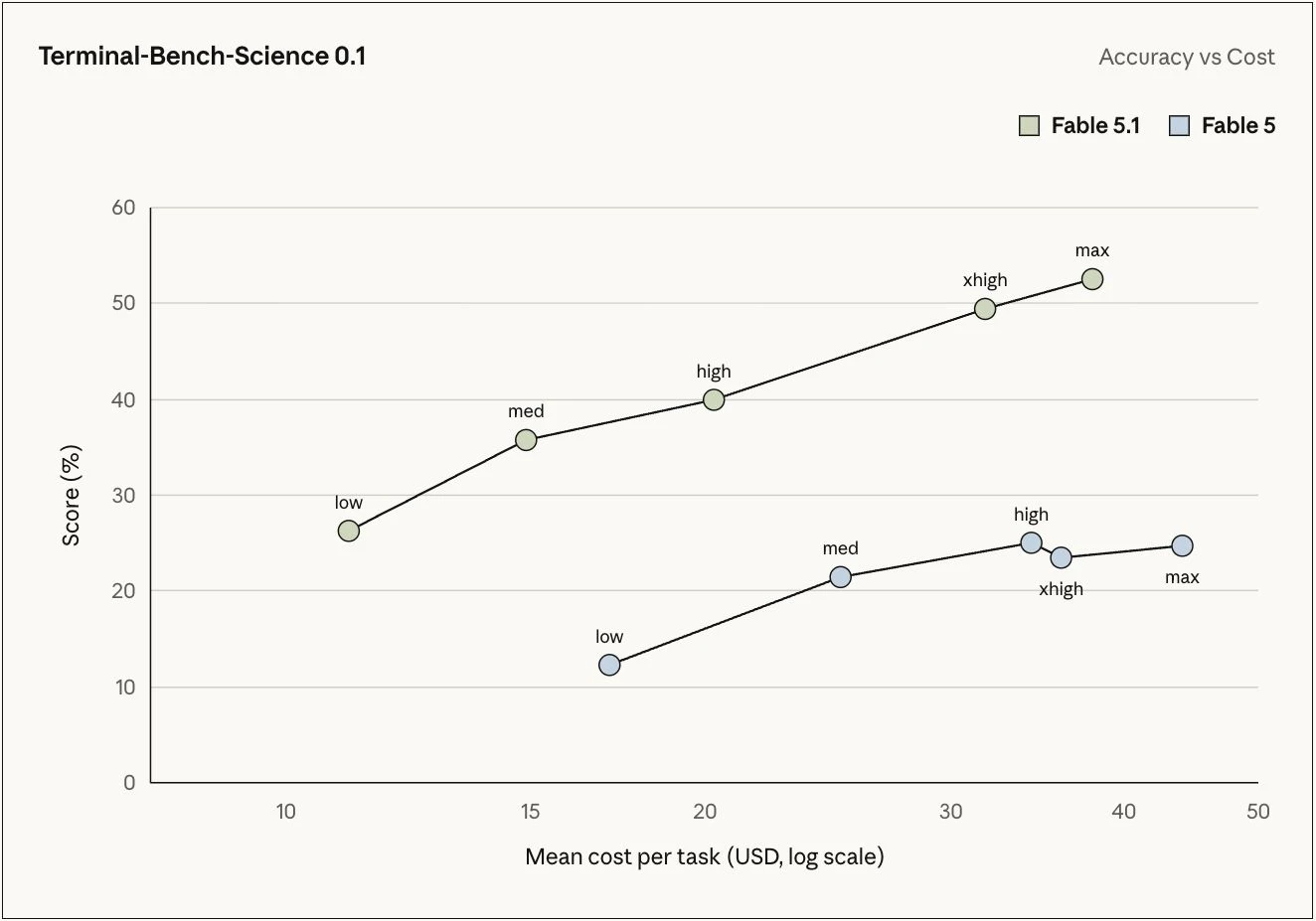
Anthropic launched Claude Fable 5.1 as a generally available model on September 1, 2026, and both the public benchmarks and our internal tests agree that it’s a strong model, with improvements on long-context tasks, cost efficiency, and agentic performance. The biggest jump on benchmarks is in scientific work, where on Terminal-Bench-Science 0.1, Fable 5.1 scored 26.3% at low effort, at a reported mean cost of $11.10 per task, and 52.6% at maximum effort at $37.90 per task. For comparison, Fable 5 at maximum effort scored 24.7% at $44.10 per task.
In this blog, we'll dive deeper into the areas where Fable 5.1 shows significant improvement, and share how this changes model selection for organizations working with Anthropic. We'll also discuss Mythos 5.1, which was launched alongside Fable 5.1 but requires vetting before access can be granted.
The Terminal-Bench-Science 0.1 benchmark measures an agent's ability to complete scientific computing tasks in a terminal. The work includes writing and running code, interpreting results, and continuing through multiple steps. This is where Fable 5.1 saw the largest gains, and while the benchmark itself is for a narrow domain, the performance gains should partially translate to long-running agent workflows that depend on tool output and revision. Agentic coding work also shows improvements, albeit not as dramatic. Fable 5.1 scored 55.8% on Terminal-Bench 4.0, up from 42.0% for Fable 5 and from 52.3% for Opus 5.
The results on FrontierCode 1.1 show an interesting phenomenon. Fable 5.1’s composite score peaked at medium effort and remained below Fable 5’s best result. Task-correctness pass rates continued to rise with effort, but Fable 5.1 occasionally made small changes outside the requested scope. Some were correct or helpful, but the benchmark counted out-of-scope changes as failures, resulting in lower scores. For repository work, those changes can expand a diff and increase work needed for review even when they do not break the code. It's worth noting that Fable 5.1 achieved significant results at much lower cost than the models compared.
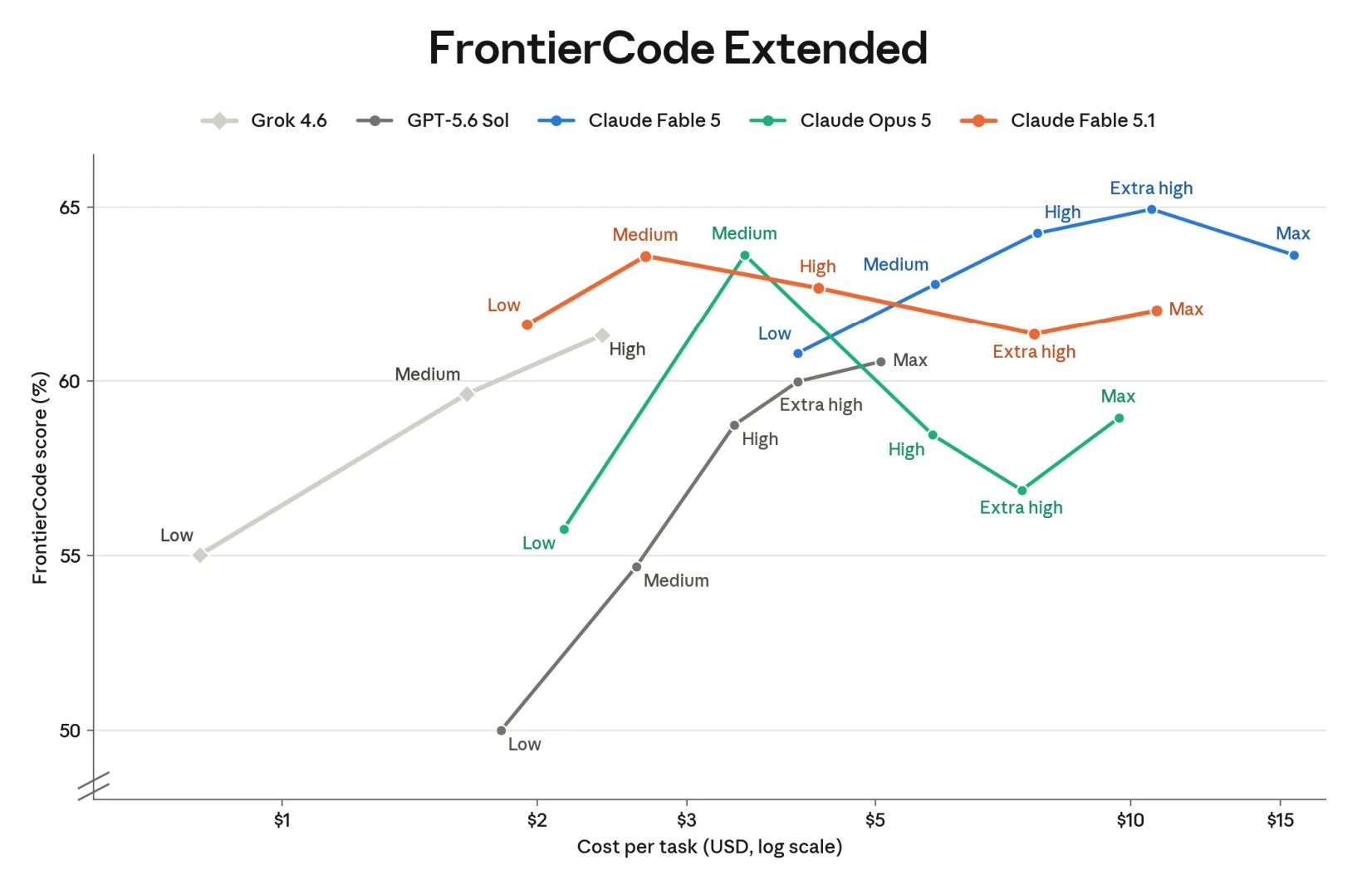
Fable 5.1 is stronger on these selected long-running coding and scientific workloads. Actual gains for your workloads will depend on the task, harness, and effort setting. Use these values as references, and run your own evaluations. Read the Fable 5.1 system card for more benchmarks run by Anthropic.
Fable 5.1 costs an estimated 25% less than Fable 5 due to a price reduction in cache reads. The cost of cache reads dropped by 75% to $0.25 per million tokens, down from $1.00 per million tokens for Fable 5. Anthropic estimates that for highly agentic work, savings will be up to about 45%.
Under Anthropic’s published pricing, base input remains $10 per million tokens, and output remains $50, the same prices as for Fable 5. Five-minute cache writes remain at $12.50 per million tokens, and one-hour cache writes remain at $20.
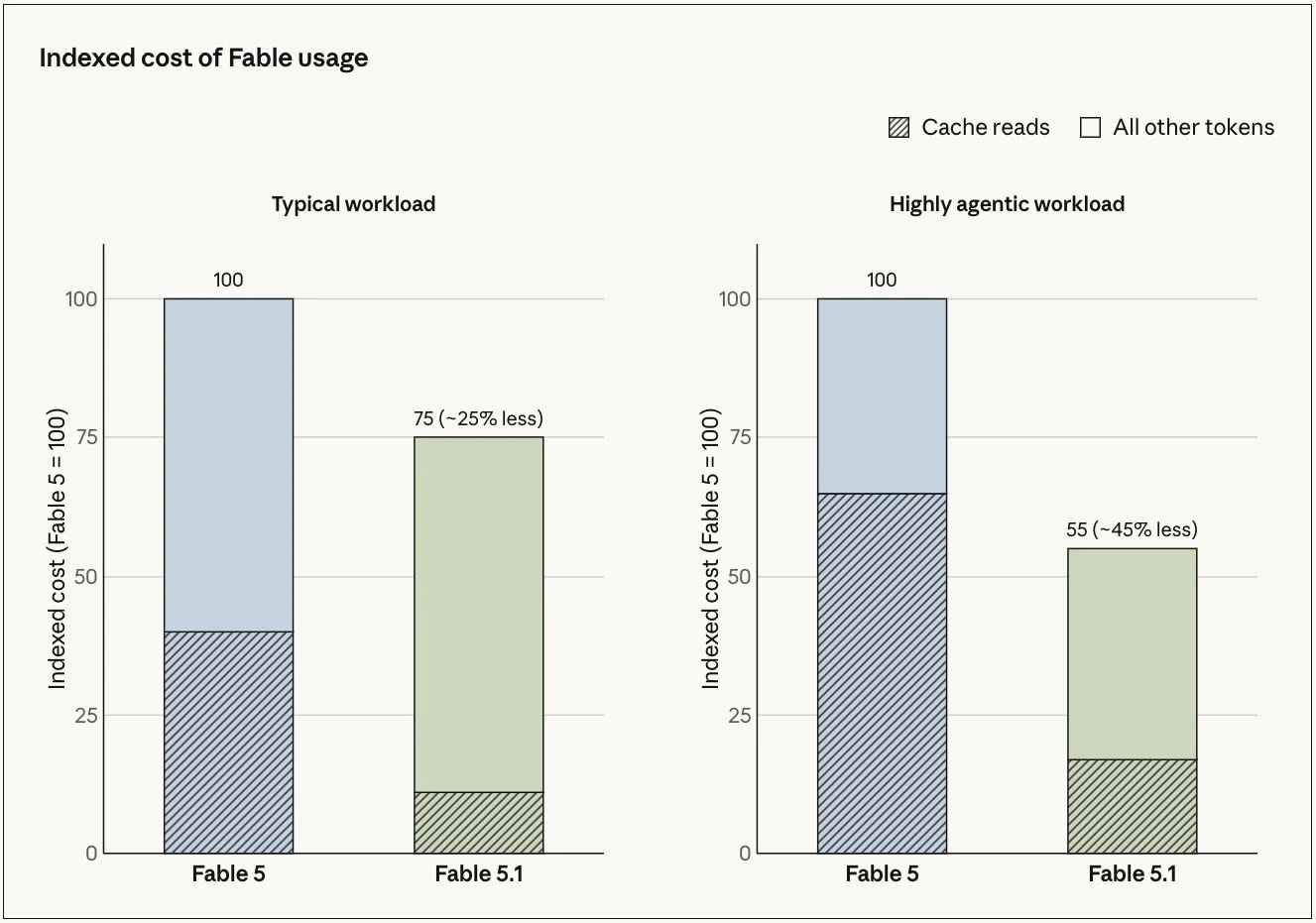
Another avenue towards cost reduction is Fable 5.1's performance curve. You may find that some workloads previously running on Fable 5 or even on Opus 5 now meet their quality targets with Fable 5.1 at a lower effort setting. Of course, this will require careful evaluation on each specific workload.
The Terminal-Bench-Science results show the separate effect of effort. The table should be read as one benchmark’s quality-cost curve, not as a forecast for your specific workloads.
One thing to keep in mind is that adaptive thinking cannot be disabled in Fable 5.1, although the model may skip thinking for simple requests. When it generates thinking tokens, they are billed as output. A higher effort setting can therefore increase cost even when the request and cached prefix remain unchanged.
The practical comparison point for organizations evaluating migrating existing workloads to Fable 5.1 is the lowest effort that meets the workload’s acceptance criteria. That test should measure task success, latency, base input, cache writes, cache reads, output tokens, and total cost. Testing Fable 5.1 at different effort settings will yield the measurements you need for an effective comparison on your specific workload.
Fable 5.1 and Mythos 5.1 use identical model weights, but their safeguards and access controls produce different deployed behavior, as was the case with Fable 5. However, there have been some changes in the safeguards and the types of work that Fable is allowed to take on.
Anthropic now allows Fable 5.1 to identify vulnerabilities in source code, while penetration testing, exploit generation, and binary vulnerability scanning continue to route to Opus. Professional life-sciences research and development also routes to Opus. Anthropic reports around 60% fewer cyber-safeguard interventions per Claude Code session and 85% fewer interventions on benign elementary biology and medical questions than the safeguards used when Fable 5 launched.
Safeguard behavior also changes API handling and billing. A request can return HTTP 200 with stop_reason: "refusal" and structured stop_details. With configured fallback, the refused Fable attempt is not billed when it stops before producing output, and any response produced by the configured fallback is billed at the fallback model’s rate. If Fable has already begun streaming, it bills input and generated output before the fallback attempt. Fallback credit avoids charging the prompt-cache switching cost twice, but fallback can still add latency and move the completion to a different model.
Server-side fallback is available in beta through the Claude API. Amazon Bedrock and other partner platforms require implementing fallback in the client or SDK. Claude applications enable automatic model switching by default, while API use requires configuration. Tests that use different access paths can therefore exercise different routing behavior even when they submit similar prompts.
Existing integrations can fail or behave differently after a model-ID update. The Fable 5.1 migration guide identifies three breaking changes: forced tool choice, compatibility of Fable 5.1 thinking blocks with earlier models, and binding between preserved thinking and earlier conversation content.
Requests that use tool_choice values any or a named tool return HTTP 400. The supported values for Fable 5.1 are auto and none. A workflow that requires forcing a tool call can keep tool_choice on auto, instruct the model to use the named tool, and apply strict: true when arguments must follow a schema. When the forced tool choice served only to produce schema-valid JSON, structured outputs are the appropriate replacement. This changes behavior enough to require regression testing against the workflow’s completion criteria.
Thinking-block compatibility works in one direction. Fable 5.1 can read thinking blocks from earlier Claude models, but earlier models cannot read Fable 5.1 thinking blocks. This means that when a conversation returns to an earlier model, the API removes the incompatible blocks before inference. Without the thinking-binding-controls-2026-08-01 beta header, the removal is silent. The earlier model then replans, which increases first-turn latency and token use.
Preserved thinking is also bound to the conversation that produced it. Editing an earlier message, system prompt, tool definition, document, or image can invalidate later thinking blocks. Strict binding applies automatically to Claude Platform organizations, Amazon Bedrock accounts, Vertex AI projects, and Microsoft Foundry projects created on or after August 31, 2026. Pre-existing accounts can opt into it for Fable 5.1. Context compaction, reminder injection, routing, and history-rewriting logic should be tested under the applicable account and platform behavior, since they may behave differently with Fable 5.1.
In long-running agent loops, Fable 5.1 may issue fewer parallel tool calls than Fable 5, sometimes calling just one tool per turn. That behavior can add round trips, tokens, and latency as calls are sequentialized and potentially more turns are needed. At low effort, the model may search or retrieve less frequently and rely more on existing knowledge, even with the same prompt as Fable 5. Progress updates during tool sequences may also be less frequent, so regression testing should cover request validity, preserved context, retrieval freshness, tool-loop latency, and the evidence shown to users while work is in progress.
These changes mean Fable 5.1 is not a drop-in replacement for either Fable 5 or any other model. You will need to do some work to adapt your application and its API calls to work with Fable 5.1. Moreover, our usual advice still holds: use public benchmarks as guidance, and run your own evaluations for every workload before deciding whether a model is an improvement. You might need to make prompt adjustments based on what your own evaluations show.
Prompts and completions for Fable 5.1 are retained for at least 30 days by default wherever the model is offered, including third-party cloud platforms. Under Anthropic’s Covered Model terms, zero data retention is unavailable unless Anthropic expressly authorizes an exception.
Anthropic says a limited set of eligible customers may receive temporary ZDR terms while Enterprise Frontier Safeguards (EFS) becomes available. Under the announced EFS design, customers can opt to keep monitoring data in their own cloud account under their own encryption keys, access policies, and audit logging. Anthropic describes the design as providing privacy comparable to ZDR. EFS's phased rollout is planned to start later in fall 2026.
Amazon Bedrock provides Fable 5.1 through bedrock-runtime and bedrock-mantle, with prompt caching on both. The endpoint and Region determine the available inference profile. It supports the Standard service tier and requires an aws_review retention opt-in through the Amazon Bedrock Data Retention API. Fable 5.1 can also be accessed via Claude Platform on AWS, which uses Anthropic’s first-party Messages API.
Watermarking is active for Fable 5.1 outputs. The invisible statistical pattern adds no hidden characters or tokens and contains no identifiers for the user, organization, or conversation. Access to the detection API remains in private preview. Detection estimates whether Claude contributed to a text rather than establishing authorship, and reliability declines for short, factual, code-heavy, proofread, or heavily rewritten content.
Fable 5.1 provides strong evidence of better performance on selected long-running technical workloads, and you should expect those improvements to translate to most long-running workloads. Lower cache-read pricing improves the economics of applications that reuse substantial context, while the effort curve creates another possible source of savings when a workload can meet its quality target below maximum effort.
Effort, cache behavior, safeguards, fallback, API behavior, retention terms, and access path can all change the result an application receives. Moreover, some of these changes are not backward-compatible. Run your own workload-specific evaluations before replacing any model with Fable 5.1.
Fable 5.1 brings meaningful improvements in long-running technical workloads, cost efficiency, and agentic performance, but realizing those benefits requires more than swapping model IDs. Caylent can help you evaluate Fable 5.1 against your real-world workloads, identify the right effort settings and architecture, navigate API and safeguard changes, and build production-ready solutions on AWS with Amazon Bedrock. As a Preferred Services Partner and Charter Member of the Claude Partner Network with a dedicated Anthropic practice, and an AWS Premier Tier Services Partner, we help organizations assess model selection, navigate governance and data retention requirements, optimize costs, and build production-ready AI solutions that balance performance, security, and operational efficiency. Get in touch with us today to get started.
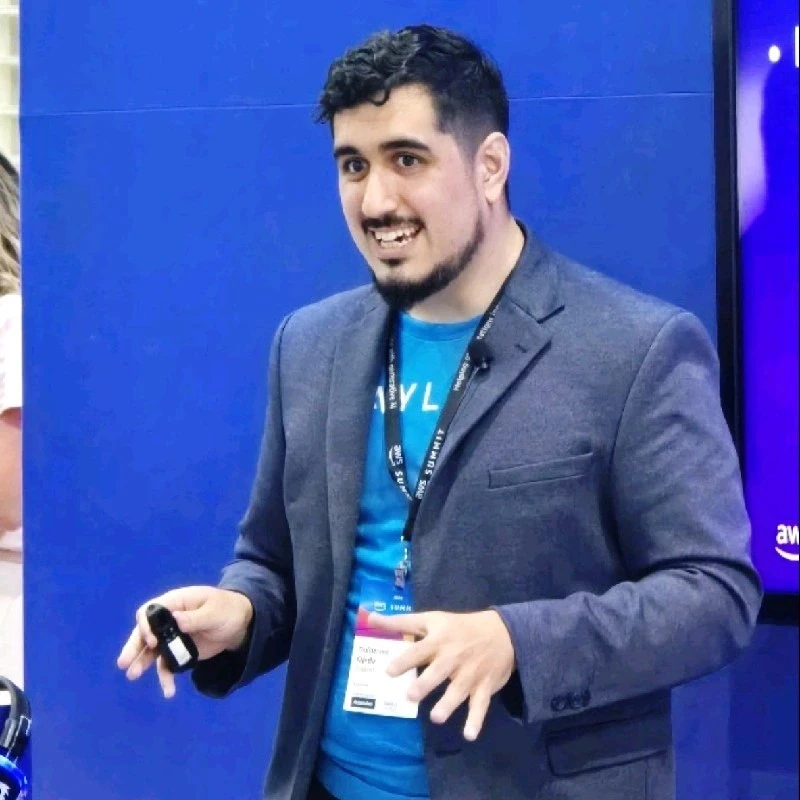
Guille Ojeda is a Principal Innovation Architect at Caylent, a speaker, author, and content creator. He has published 2 books, over 200 blog articles, and writes a free newsletter called Simple AWS with more than 45,000 subscribers. He's spoken at multiple AWS Summits and other events, and was recognized as AWS Builder of the Year in 2025.
View Guille's articlesCaylent Catalysts™
Accelerate your generative AI initiatives with ideation sessions for use case prioritization, foundation model selection, and an assessment of your data landscape and organizational readiness.
Caylent Catalysts™
Accelerate investment and mitigate risk when developing generative AI solutions.

Explore what’s new in Claude Sonnet 5.5, including its improvements, where it fits alongside other Claude models, and what organizations should know before migrating.