 Guille Ojeda
Caylent Catalysts™
Generative AI Strategy
Accelerate your generative AI initiatives with ideation sessions for use case prioritization, foundation model selection, and an assessment of your data landscape and organizational readiness.
Explore Claude Fable 5, Anthropic's most capable generally available model, and learn how its advanced reasoning capabilities, safeguards, pricing, and deployment considerations impact real-world enterprise AI adoption.
Claude Fable 5 is the most capable model Anthropic, or anyone really, has ever made generally available as of the publishing date of this article. Its capabilities are not even in question. The right question is how much better Fable 5 is, on what work, at what cost, and under what conditions.
In this blog, we'll analyze what Fable is good at and how good it is, where the capability lead makes a significant difference, how the $10 / $50 pricing behaves considering Fable's safeguards that cause some requests to fall back to Opus 4.8, and what adopting Fable 5 will cost for an organization.
On April 7th, 2026, Anthropic announced they had completed training of a new model: Mythos. They withheld its release, claiming it was too dangerous for public use, and made it available only to select partners through Project Glasswing. Fast forward to June 9th, Anthropic shared they were releasing the first publicly available Mythos-class model: Fable 5. The model was only available for three days because on June 12th, the United States Department of Commerce declared an export ban on Mythos 5 and Fable 5. Anthropic wasn't allowed to grant any foreign nationals access to Fable, including Anthropic's own non-US employees. Due to the complexities of determining users’ nationalities, Anthropic decided to temporarily revoke access to Fable 5 for everyone. On June 30th, the United States Department of Commerce lifted the export ban on Fable 5, and in response, Anthropic redeployed the model, and on July 1st, gradually started granting access again for all users.
Fable 5 belongs to a tier Anthropic calls Mythos-class, which the company positions above its Opus class in capability. It is not the next release in the Opus line under a new name, instead, it is the first model from a higher tier that the public can use at all.
The tier appeared in April with Claude Mythos Preview, which Anthropic restricted to a limited group of cyber defenders and critical-infrastructure providers, citing the model's ability to find and exploit software vulnerabilities at a rate that would cause significant problems for the digital world if the model were misused. Anthropic said at the time that it intended to bring Mythos-level capability to all of its users once its safeguards could reliably prevent misuse. Fable 5 is that release.
Fable 5 launched alongside Claude Mythos 5, and the two have the same underlying model. The names indicate differences in safeguards, not in weights or training: Mythos 5 runs with safeguards lifted in specific areas, while Fable 5 runs with all safeguards in place.
Mythos 5 is not broadly available as Anthropic limits it to Project Glasswing cybersecurity partners, who receive it with the cyber safeguards removed. The company plans a second configuration, with biology and chemistry safeguards removed and cyber safeguards intact, for a small group of biology researchers. Meanwhile, Fable 5 is available for everyone. It has the same capabilities, but with stricter safeguards on. Because the models share weights, the safeguards and the classifiers that trigger them are of significant practical importance. They determine what prompts Fable answers itself, what work falls back to Opus 4.8, how predictable this behavior is on a given workload, and what the actual costs are.
Whether Fable 5 answers a request comes down to a set of classifiers, which are separate AI systems that screen the inputs for three categories of work:
A request on Claude.ai flagged by these classifiers is not refused. Opus 4.8 produces the response instead, and the user is told the handoff happened.
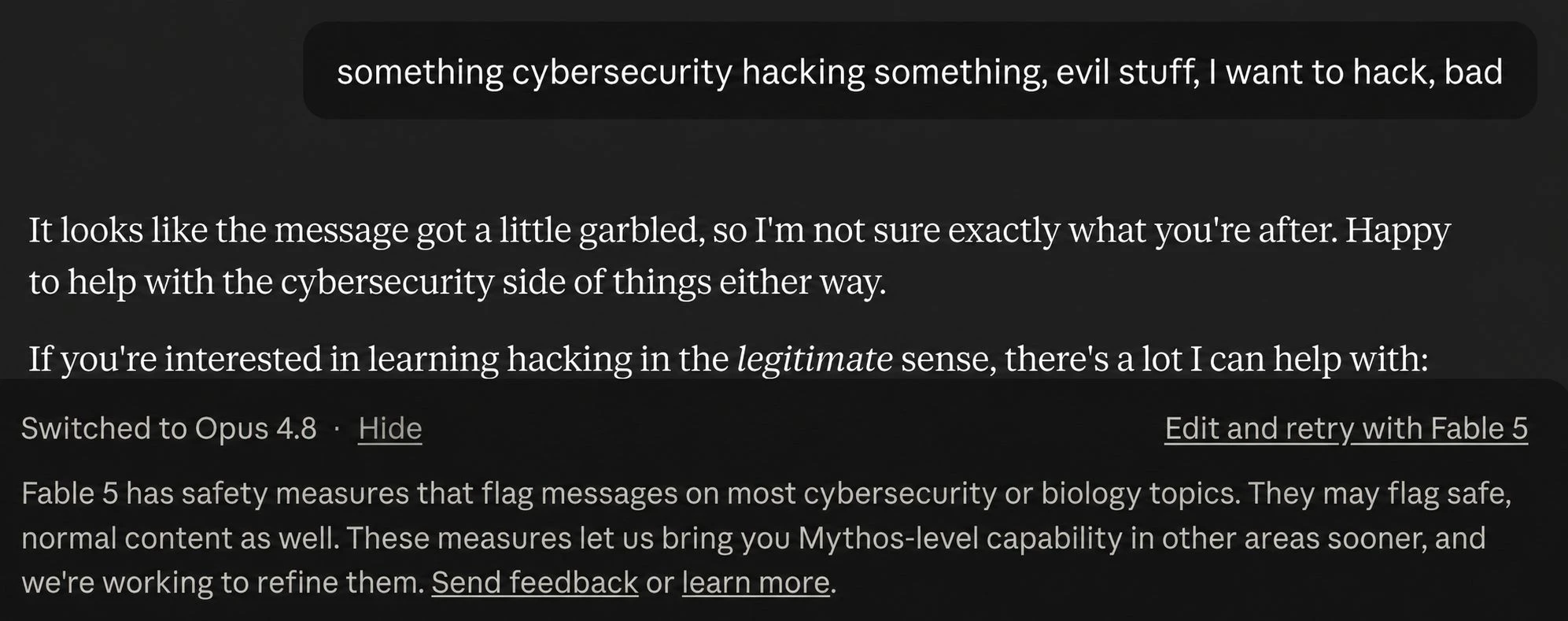
Anthropic's early data puts fallback-free sessions above 95%, and in those sessions, Fable 5 performs identically to Mythos 5. Our initial experience had been much more conservative, with multiple false positives that caused Fable 5 to fall back to Opus 5 on topics unrelated to the safeguards. The classifiers had been tuned very conservatively for launch, so many harmless requests in or near the three areas were also routed to Opus.
As part of the process that led to the US Government lifting the ban on Mythos-class models, Anthropic worked with US Government agencies to train specific classifiers to block the dangerous behaviors that initially led to the model's ban. These new classifiers block these behaviors in over 99% of cases, and even if the request isn't blocked, Anthropic claims the model will deliver responses that are not detailed enough to help a cyberattacker. The model’s safeguards are not meant to block all low-risk routine cyberdefense capabilities, only potentially harmful ones.
Our own tests with these new classifiers, using Fable 5 after its redeployment, have shown a significant decrease in false positives, with Fable 5 handling a higher portion of genuine requests.
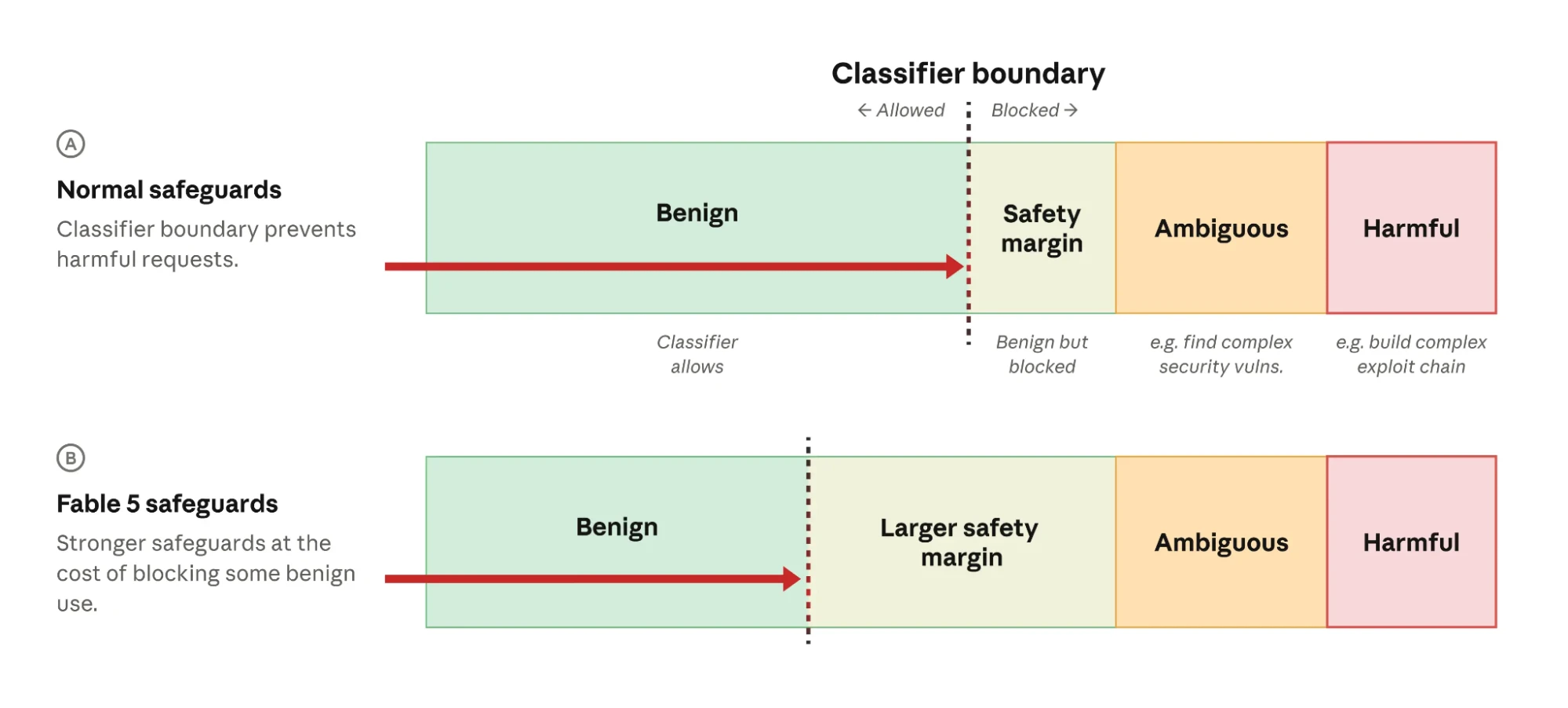
Both the old and the new classifier come at the cost of flagging benign requests rather often during routine coding and debugging tasks, to the point that “near-term” coding and debugging tasks will fall back to Opus 4.8. Anthropic stated they will continue to refine this to better distinguish genuine misuse from legitimate requests and reduce false positives.
Fable 5 is unquestionably the most intelligent generally available model, even considering that for some requests it will fall back to Opus 4.8 (which is an extremely capable model itself). Here is the public benchmark Intelligence Index from Artificial Analysis:
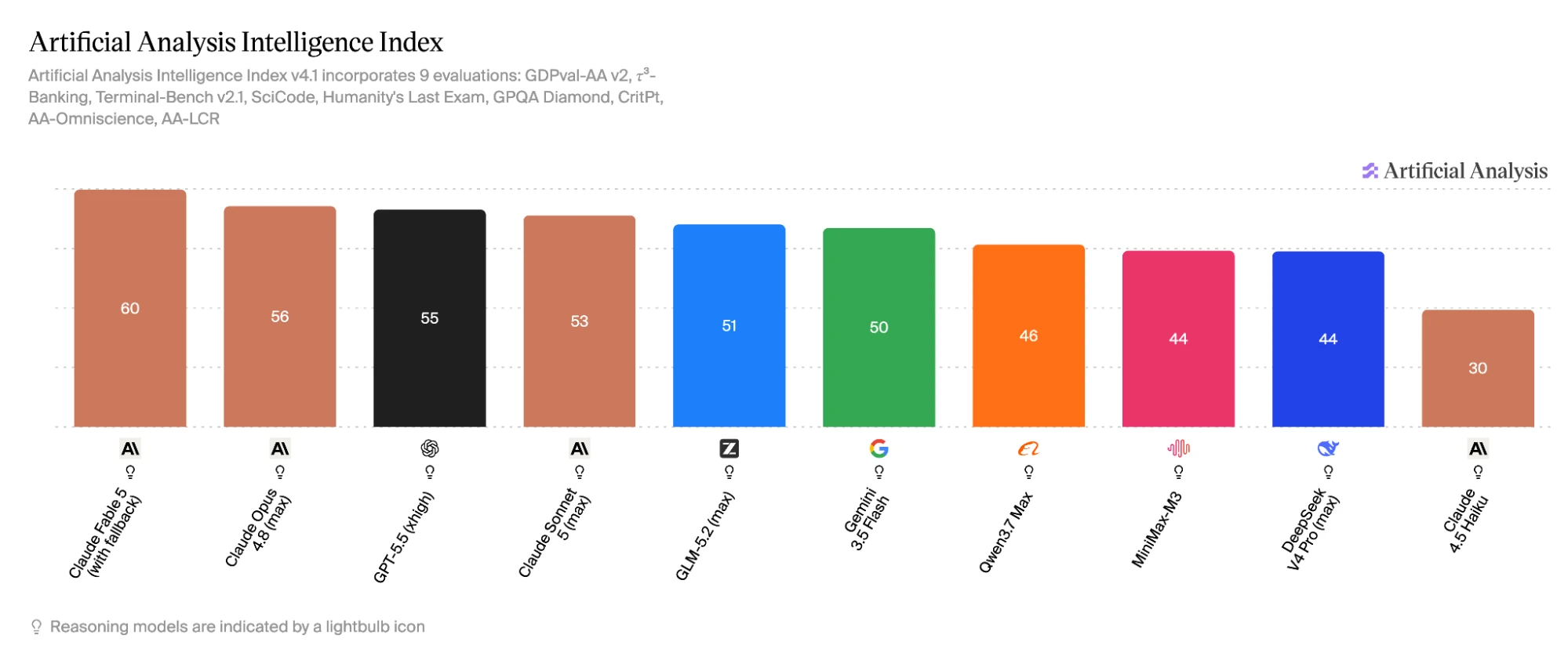
As usual, benchmarks are a fantastic way to assess a model's general capabilities. However, determining which model is the best for your specific workloads requires task-specific evaluations. Moreover, the question isn't which model is most capable at some specific tasks, but rather which model offers the best combination of performance and price for a specific workload.
From our tests at Caylent, we've found that Fable's capabilities are worth the price on long-horizon tasks. The longer and more complex the task, the larger Fable 5's lead over any other available model becomes. The price of Fable pays off in the long-horizon, for autonomous work rather than quick, well-scoped requests.
Fable 5 and Mythos 5 are priced at $10 per million input tokens and $50 per million output tokens. That's double Claude Opus 4.8's standard rate of $5 / $25, and less than half what Anthropic charged for Mythos Preview. Sonnet 5 runs at $2 / $10 (set to increase to $3 / $15 after September 1st), so there's a significant gap between the perfectly capable mid-tier model Sonnet 5 and the best-in-class Fable 5.
The sticker rate is not the whole calculation, as we need to take into account the refusals that Fable is prone to, and how fallback works. Claude.ai, Claude Cowork, Claude Code, and Claude Design come with automatic fallback to Opus 4.8 enabled by default, and your request will count toward your usage limits as if it had originally been sent to Opus 4.8.
When using Fable 5 on Amazon Bedrock or via the Claude API, refusals will not automatically result in a fallback. When a classifier blocks a request to Fable 5 on Bedrock, the API returns an HTTP 200 response with stop_reason: "refusal" and a stop_details object containing the restriction category. You have a few options to configure how the fallback happens, if at all.
Server-side fallback retries a request that was refused, within the same API call. You name up to three fallback models, and when Claude Fable 5 declines, the API runs the next model in the chain on the same request. You get back a response naming the model that answered, so your user gets an answer in one round trip.
On a streaming request, the retry happens on the same stream, and nothing you have already received is invalidated. If the decline happens mid-output, the fallback model continues from the partial output. For a non-streaming request, if a decline occurs mid-output, the response omits the declined model's partial output, and the fallback model responds from scratch.
The TypeScript, Python, Go, Java, and C# SDKs include a refusal-fallback middleware. You configure it once on the client with your list of fallback models. Calls through client.beta.messages then retry refused requests automatically, on any platform.
At this point, you might be wondering what happens to prompt caches, since they are typically set per model. When Claude Fable 5 declines a request and you retry on another model, the conversation prefix that was already cached for Claude Fable 5 must be written into the new model's cache from scratch. Cache writes cost more than cache reads, so this would be problematic for your costs. However, Anthropic released a mechanism called fallback credit that removes that extra cost. The refusal carries a credit token, you then echo the token on the retry, and the retry is billed as though the conversation had been on the new model all along.
When using server-side fallback, this happens automatically on the server. When using the SD middleware, it automatically sends the fallback-credit-2026-06-01 beta header on every fallback request it handles, so retries are repriced without per-request setup. If you're using the Ruby or PHP SDK, sending requests over raw HTTP, or using custom retry logic, you need to set this up manually by following this page.
Estimating Fable 5's cost for a real workload therefore takes two inputs: token volume and how much of the traffic sits in or near the three classifier domains (or it may get mistakenly classified as if it belonged to those domains). A general-purpose workload will bill close to the Fable rate (assuming a low number of false positives, for example, when trying to perform a security review on the code), while a workload that gets frequently caught by the classifiers will land somewhere between Fable and the fallback model you use.
Fable 5 also arrives with a data-handling requirement that applies regardless of workload. Anthropic requires 30-day retention for all traffic on Mythos-class models, including Fable 5, Mythos 5, and future models with similar or higher capabilities. This applies to both Anthropic's own surfaces (Claude.ai, Claude Desktop, Claude Code, Claude Design, and the Anthropic API) and to third-party platforms such as Amazon Bedrock.
Retaining traffic data lets Anthropic detect attacks that unfold across many requests and eventually reduce false positives from the model's guardrails. The company says the data is not used to train models, that human access is logged, and that data is deleted after 30 days in nearly all cases. On AWS, meeting the requirement has an additional consequence: invoking Fable 5 on Amazon Bedrock requires opting into data sharing by setting data_retention to provider_data_share, and AWS's documentation very clearly states that shared data leaves AWS's security boundary.
Fable 5 is Anthropic's first publicly available Mythos-class model, made fit for the public with safeguards, then blocked due to a lack of confidence in those safeguards, and now made available again with improved safeguards.
The launch comes with very strong claims, and each carries a boundary that is easy to lose in a roadmap or a budget:
The teams running long-horizon, agentic, or document-heavy work that earlier models could not perform reliably have the most to gain. The teams that run workloads near the classifier domains of cybersecurity, life sciences, or model distillation, or that have data-handling requirements that the 30-day retention complicates, might prefer or be forced to skip Fable 5 entirely.
Fable 5 is generally available as claude-fable-5 on the Claude API, and through Amazon Bedrock and the Claude Platform on AWS as anthropic.claude-fable-5. The model is also available to Claude subscribers on Pro, Max, Team, and Enterprise plans, with a maximum of 50% of their plan's capacity available for Fable.
Whether you're evaluating Claude Fable 5 for autonomous software development, document intelligence, or complex agentic workflows, Caylent can help you identify where its capabilities deliver meaningful business value and where other models may be a better fit. As a Preferred Services Partner and Charter Member of the Claude Partner Network, and an AWS Premier Tier Services Partner, we help organizations assess model selection, navigate governance and data retention requirements, optimize costs, and build production-ready AI solutions on Amazon Bedrock that balance performance, security, and operational efficiency. Get in touch with us today to get started.
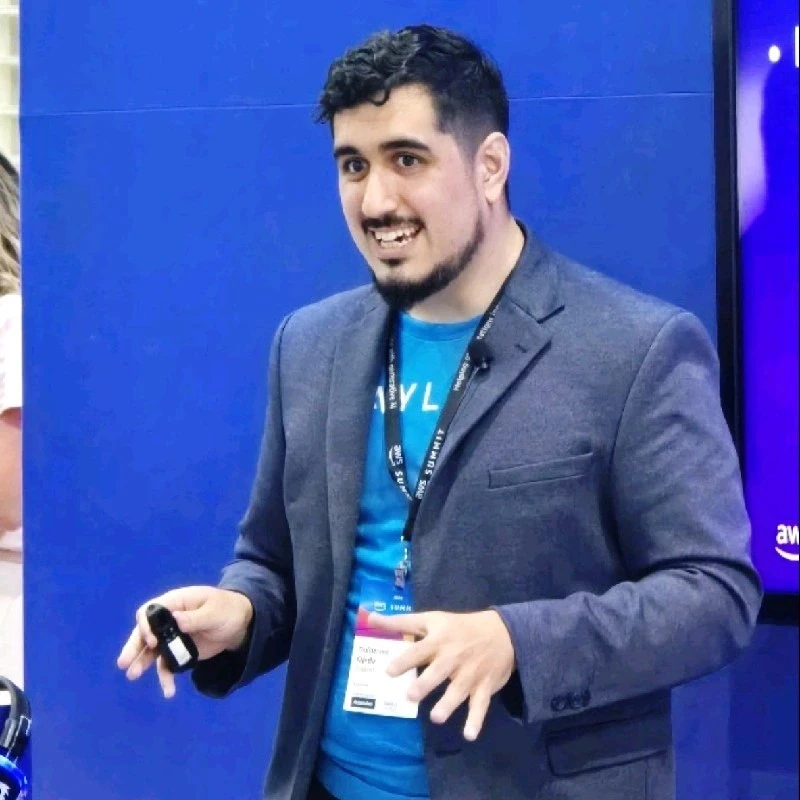
Guille Ojeda is a Principal Innovation Architect at Caylent, a speaker, author, and content creator. He has published 2 books, over 200 blog articles, and writes a free newsletter called Simple AWS with more than 45,000 subscribers. He's spoken at multiple AWS Summits and other events, and was recognized as AWS Builder of the Year in 2025.
View Guille's articlesCaylent Catalysts™
Accelerate your generative AI initiatives with ideation sessions for use case prioritization, foundation model selection, and an assessment of your data landscape and organizational readiness.
Caylent Catalysts™
Accelerate investment and mitigate risk when developing generative AI solutions.
Leveraging our accelerators and technical experience
Browse GenAI Offerings
Explore what’s new in Claude Haiku 5.5, including what's improved, where Haiku fits alongside the latest Sonnet, Opus, and Fable models, and what has changed in pricing, API behavior, and safeguards.
Explore what’s new in Claude Sonnet 5.5, including its improvements, where it fits alongside other Claude models, and what organizations should know before migrating.
