 Guille Ojeda
Caylent Catalysts™
Generative AI Strategy
Accelerate your generative AI initiatives with ideation sessions for use case prioritization, foundation model selection, and an assessment of your data landscape and organizational readiness.
Caylent’s analysis of Claude Sonnet 5, Anthropic's most agentic Sonnet model yet, with improvements in coding, agentic workflows, computer use, professional knowledge work, and tool use.
Updated on August 24, 2026
On June 30, 2026, Anthropic announced Claude Sonnet 5, describing it as the most agentic Sonnet model yet. The launch makes the model available across Claude plans, Claude Code, Claude Platform, and Amazon Bedrock, with claude-sonnet-5 available through the Claude API. Sonnet 5 improves the Sonnet line for coding, agentic work, tool use, computer use, and professional knowledge work. It also changes the operating surface through adaptive thinking, effort levels, a new tokenizer, request-compatibility constraints, and cyber-safety behavior.
The practical reading for enterprise teams is narrower than “newer model, better model”. Sonnet 5 raises the Sonnet baseline and can change the cost-performance profile for some workloads, but it still needs task-level validation against real codebases, tools, documents, latency targets, cost targets, and safety requirements. In this article, we'll explain what changed and share what organizations should validate.
Teams that use Sonnet as their default Claude tier usually prioritize balance. They require enough reasoning and tool use for serious work, with cost and latency that can support high-volume usage. Sonnet 5 maintains that balance while delivering significant improvements in coding and tool-use domains, nearly catching up to Opus 4.8 while maintaining the Sonnet price.
Sonnet 5 comes with a 1M-token context window by default, 128K maximum output tokens, adaptive thinking support, and the claude-sonnet-5 model ID. Anthropic's launch post describes Sonnet 5 as a drop-in upgrade for Sonnet 4.6 with three launch behavior changes:
The baseline that comes to mind for comparison with Sonnet 5 is Sonnet 4.6, but the most useful reference point is actually Opus 4.8. Sonnet 5 is a good upgrade for workloads running on Sonnet 4.6 that would benefit from stronger coding, tool use, and agentic follow-through. Opus 4.8 remains the higher-capability reference for complex reasoning, long-horizon agentic coding, and high-autonomy work, but the gap is significantly smaller.
Sonnet 5 is priced at $2/$10 per million input/output tokens, with no price increases planned. The price reduction on the Sonnet family, which is 33% lower than Sonnet 4.6 at $3/$15 per million input/output tokens, is meant to offset the average 30% increase in tokens caused by the new tokenizer Anthropic is using. Launch documents say this adjustment should keep Sonnet 4.6 workloads the same cost when run on Sonnet 5. Originally, this price reduction was supposed to be temporary, and Sonnet 5's price was going to increase to $3/$15 per million input/output tokens on September 1st, 2026. That price increase was cancelled on August 10th, and Anthropic confirmed Sonnet 5's price will remain at $2/$10 per million input/output tokens. For reference, Opus 4.8 has a price point of $5/$25 per million input/output tokens.
Anthropic’s public benchmark chart reports Sonnet 5 at 63.2% on SWE-bench Pro versus 58.1% for Sonnet 4.6, 80.4% on Terminal-Bench 2.1 versus 67.0%, and 81.2% on OSWorld-Verified versus 78.5%. It also reports gains on Humanity’s Last Exam and GDPval-AA v2, with Opus 4.8 still ahead on several measures, but with a noticeably smaller advantage.
Those results align with the launch’s strongest workload categories as observed by Caylent: coding, agentic work, and computer use. However, neither a public benchmark nor honest and well-informed advice from a third party like Caylent can tell you whether Sonnet 5 is the best choice for your specific workloads. You need to test whether it follows your specific engineering team’s conventions, handles your proprietary documents correctly, respects your internal permissions, uses your company’s tools safely, or produces acceptable results to you at your required cost and latency.
Teams already using Sonnet 4.6 for code review, code generation, terminal-driven tasks, browser automation, complex document analysis, or financial workflows have a strong reason to test Sonnet 5, and we encourage them to be optimistic but draw their own conclusions. Teams running narrower extraction, classification, routing, or summarization tasks may find that latency, token count, output consistency, and cost are more useful measures than the headline benchmark categories, though testing Sonnet 5 is still worth it.
Adaptive thinking is on by default for Sonnet 5, letting the model determine when and how much thinking to use based on request complexity. On the Claude API, teams can disable it with thinking: {type: "disabled"}. Trying to set it manually with thinking: {type: "enabled", budget_tokens: N}, like on previous models, is rejected with a 400 error.
Effort is the practical control for response depth, with high being the default, xhigh as a suitable option for long-running agentic and coding tasks, medium as a balanced level, low as the most efficient level for simpler or latency-sensitive tasks, and max as the highest-capability option without token-spend constraints. When enabled, effort affects all response tokens, including text, explanations, tool calls, function arguments, and thinking.
Lower effort can reduce cost and latency, but it can also change how deeply the model checks alternatives or how many tool calls it makes. Higher effort can improve difficult work, but it can add spend where the extra reasoning does not change the result. Treat it as another dimension to evaluate, rather than just comparing the models on the same effort.
Sonnet 5 is a strong upgrade candidate for teams already using Sonnet where coding, tool use, computer use, or longer agentic workflows affect the quality of the result. It comes closer to Opus 4.8 than previous Sonnet models while staying in the Sonnet price tier, which makes it especially relevant for teams that need stronger performance without moving every workload to the highest-cost Claude option. The cost story still needs validation. The launch discount can make Sonnet 5 close to cost-neutral for some Sonnet 4.6 workloads, but the new tokenizer and post-September pricing change the long-term economics.
The best place to test Sonnet 5 first is where it can reduce correction loops. Engineering teams should evaluate it against real repositories, implementation tasks, debugging, refactoring, terminal workflows, and code review. Platform teams should measure tool selection, recovery from intermediate errors, permissions behavior, latency, token consumption, and effort levels. Business teams should be more cautious with document and analysis workflows, where Caylent has not observed a significant improvement over Sonnet 4.6 and where sycophancy may require prompt-level correction.
Sonnet 5 gives organizations a stronger balanced model for serious work, but it does not remove the need for disciplined evaluation. The practical question is not whether Sonnet 5 is better in general, the benchmarks show that it is. It is whether the model improves your specific workflows enough to justify the cost, API changes, safety behavior, and potential prompt updates that come with adopting it.
For organizations ready to move from evaluation to production with Claude Sonnet 5, Caylent helps bridge the gap with deep enterprise experience across AWS and Anthropic’s ecosystem. As a charter member of the Anthropic Claude Partner Network and a Preferred Services Partner, Caylent has a dedicated Anthropic practice focused on helping enterprises design, build, and scale agentic AI systems with Claude. We can help teams validate Sonnet 5 on real workloads, optimize cost and performance trade-offs, and deploy secure, tool-using agents integrated with existing systems and governance. Reach out to us today to get started.
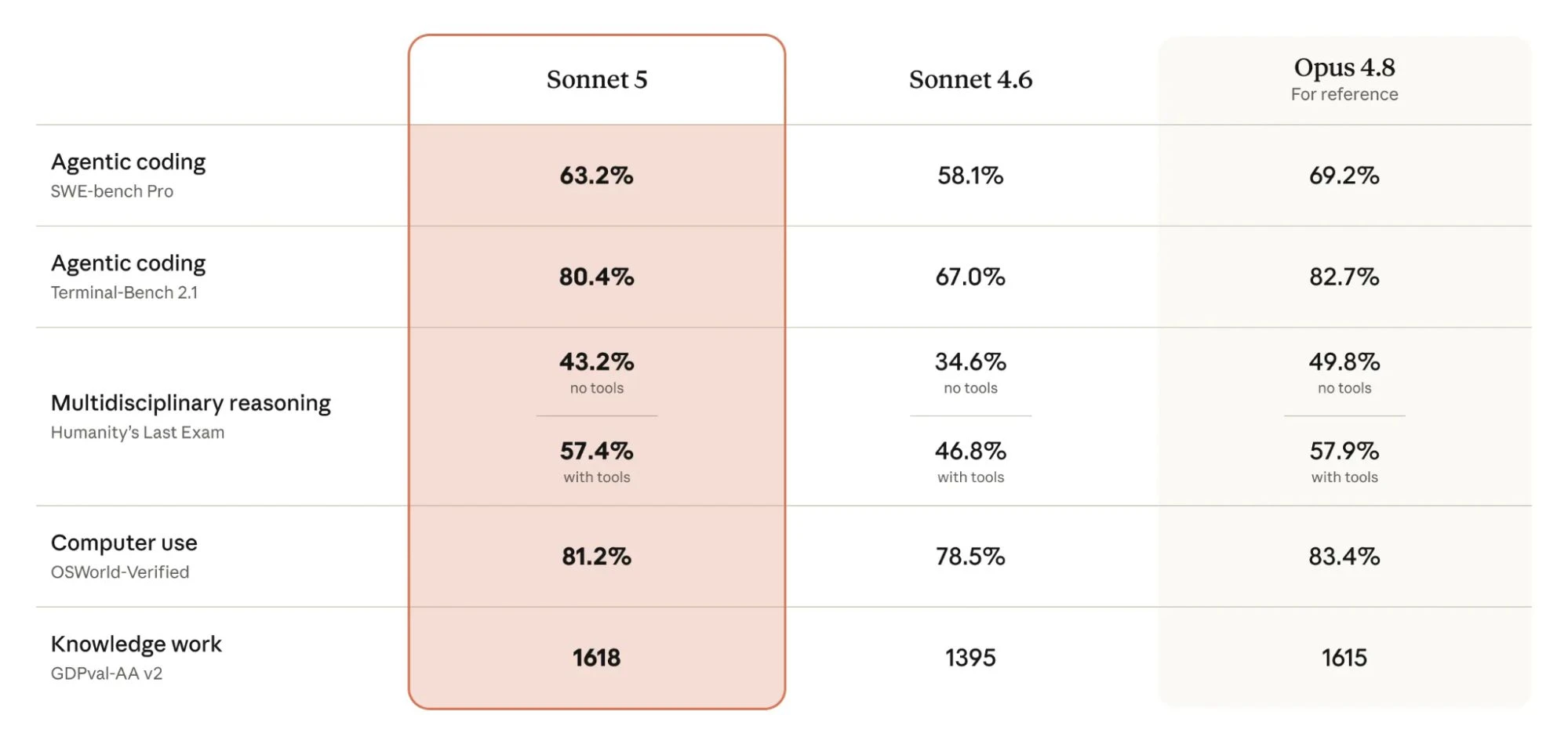
Anthropic’s public benchmark chart reports Sonnet 5 at 63.2% on SWE-bench Pro versus 58.1% for Sonnet 4.6, 80.4% on Terminal-Bench 2.1 versus 67.0%, and 81.2% on OSWorld-Verified versus 78.5%. It also reports gains on Humanity’s Last Exam and GDPval-AA v2, with Opus 4.8 still ahead on several measures, but with a noticeably smaller advantage.
Those results align with the launch’s strongest workload categories as observed by Caylent: coding, agentic work, and computer use. However, neither a public benchmark nor honest and well-informed advice from a third party like Caylent can tell you whether Sonnet 5 is the best choice for your specific workloads. You need to test whether it follows your specific engineering team’s conventions, handles your proprietary documents correctly, respects your internal permissions, uses your company’s tools safely, or produces acceptable results to you at your required cost and latency.
Teams already using Sonnet 4.6 for code review, code generation, terminal-driven tasks, browser automation, complex document analysis, or financial workflows have a strong reason to test Sonnet 5, and we encourage them to be optimistic but draw their own conclusions. Teams running narrower extraction, classification, routing, or summarization tasks may find that latency, token count, output consistency, and cost are more useful measures than the headline benchmark categories, though testing Sonnet 5 is still worth it.
Adaptive thinking is on by default for Sonnet 5, letting the model determine when and how much thinking to use based on request complexity. On the Claude API, teams can disable it with thinking: {type: "disabled"}. Trying to set it manually with thinking: {type: "enabled", budget_tokens: N}, like on previous models, is rejected with a 400 error.
Effort is the practical control for response depth, with high being the default, xhigh as a suitable option for long-running agentic and coding tasks, medium as a balanced level, low as the most efficient level for simpler or latency-sensitive tasks, and max as the highest-capability option without token-spend constraints. When enabled, effort affects all response tokens, including text, explanations, tool calls, function arguments, and thinking.
Lower effort can reduce cost and latency, but it can also change how deeply the model checks alternatives or how many tool calls it makes. Higher effort can improve difficult work, but it can add spend where the extra reasoning does not change the result. Treat it as another dimension to evaluate, rather than just comparing the models on the same effort.
Sonnet 5 is a strong upgrade candidate for teams already using Sonnet where coding, tool use, computer use, or longer agentic workflows affect the quality of the result. It comes closer to Opus 4.8 than previous Sonnet models while staying in the Sonnet price tier, which makes it especially relevant for teams that need stronger performance without moving every workload to the highest-cost Claude option. The cost story still needs validation. The launch discount can make Sonnet 5 close to cost-neutral for some Sonnet 4.6 workloads, but the new tokenizer and post-September pricing change the long-term economics.
The best place to test Sonnet 5 first is where it can reduce correction loops. Engineering teams should evaluate it against real repositories, implementation tasks, debugging, refactoring, terminal workflows, and code review. Platform teams should measure tool selection, recovery from intermediate errors, permissions behavior, latency, token consumption, and effort levels. Business teams should be more cautious with document and analysis workflows, where Caylent has not observed a significant improvement over Sonnet 4.6, and where sycophancy may require prompt-level correction.
Sonnet 5 gives organizations a stronger, balanced model for serious work, but it does not remove the need for disciplined evaluation. The practical question is not whether Sonnet 5 is better in general, the benchmarks show that it is. It is whether the model improves your specific workflows enough to justify the cost, API changes, safety behavior, and potential prompt updates that come with adopting it.
For organizations ready to move from evaluation to production with Claude Sonnet 5, Caylent helps bridge the gap with deep enterprise experience across AWS and Anthropic’s ecosystem. As a charter member of the Anthropic Claude Partner Network and a Preferred Services Partner, Caylent has a dedicated Anthropic practice focused on helping enterprises design, build, and scale agentic AI systems with Claude. We can help teams validate Sonnet 5 on real workloads, optimize cost and performance trade-offs, and deploy secure, tool-using agents integrated with existing systems and governance. Reach out to us today to get started.

Guille Ojeda is a Principal Innovation Architect at Caylent, a speaker, author, and content creator. He has published 2 books, over 200 blog articles, and writes a free newsletter called Simple AWS with more than 45,000 subscribers. He's spoken at multiple AWS Summits and other events, and was recognized as AWS Builder of the Year in 2025.
View Guille's articlesCaylent Catalysts™
Accelerate your generative AI initiatives with ideation sessions for use case prioritization, foundation model selection, and an assessment of your data landscape and organizational readiness.
Caylent Catalysts™
Accelerate investment and mitigate risk when developing generative AI solutions.
Leveraging our accelerators and technical experience
Browse GenAI Offerings
Explore what’s new in Claude Opus 5.5, from stronger coding and knowledge-work performance to lower pricing, updated API behavior, and broader safeguards.
Explore what’s new in Claude Fable 5.1, how it compares to Fable 5, and what organizations should validate before migrating their workloads.
