Edwin Moedano
 Luis Guerra
Caylent Services
Customer Experience Transformation
From Legacy Contact Center to Intelligent CX at Scale
In an ever-changing world full of automation and soulless products, the key differentiator is the experiences that we can deliver to our customers. In this blog, we will explore how to enrich a heavy human-to-human experience using AWS AI on-demand products, gluing them with a serverless architecture.
The adoption of AI across organizations has never been faster or more aggressive, and engineering teams are increasingly building information products that process diverse data streams in production environments. A question always arises: How can we implement AI quickly in our organization?
In this blog, we focus on human interaction experiences, specifically call centers, and how Amazon Connect can enable organizations to build end-to-end call flows, from agent configurations to a wide range of automations. However, a critical gap remains: how do we leverage the data generated by these interactions to meaningfully improve customer service? And how can GenAI minimize the delay between a customer call and the direct actions taken to improve the customer experience?
Since the popularization of LLMs following the launch of ChatGPT 3.5 by OpenAI in 2022, companies, organizations, and governments have started incorporating AI into their products and services, with varying degrees of purpose and effectiveness.
AI has demonstrated clear value in enriching user experiences and in building information products from interaction data. This is particularly important when part of these experiences involve human-to-human interaction. By analyzing these interactions with AI, organizations can extract diverse information. By operationalizing those insights, they can develop information products with the potential to dramatically improve customer experiences.
Call centers require continuous human-to-human interaction. Although there are automated paths to resolutions and voicebots, there will always be scenarios that require a live agent. This is where we can use information products to improve these interactions or maintain them, taking timely action when we find something worth addressing.
What matters when analyzing a customer service call depends on the organization's core objectives, but in this case, we focus on four key areas:
With AWS, businesses that depend heavily on human-to-human interaction, such as call centers, can leverage Amazon Connect to implement their call flow configurations and virtual agents. User experiences can be improved by adding recording functionality and storing call audio in Amazon S3. From there, the question becomes: How can we enrich the metrics and build better information products from that audio source? Let's start exploring the AI services that can support these needs and how they can work together within an event-driven architecture.
The pipeline begins with Amazon Transcribe, a service that converts audio files to text. This first step can analyze the conversation, extract information, and retrieve more reference points with help from other AWS services
The next step after processing the audio transcription is to detect the call’s sentiment using Amazon Comprehend to determine if it was positive or negative. Next, Amazon Bedrock, using on-demand Large Language Models (LLMs), will generate a summary, a business improvement action, and classify the call as personal or business-related.
To deliver a unified result from processing and analyzing different data points with unique formats, Amazon Bedrock will synthesize the results, which are then converted into audio using Amazon Polly. The results and corresponding text are sent via email using Amazon SES to the designated recipients so they can take the required actions and improve service quality.
Observability is very important, so we'll create custom metrics in CloudWatch not only to monitor infrastructure but also to capture quantifiable call information and display it in a dashboard.
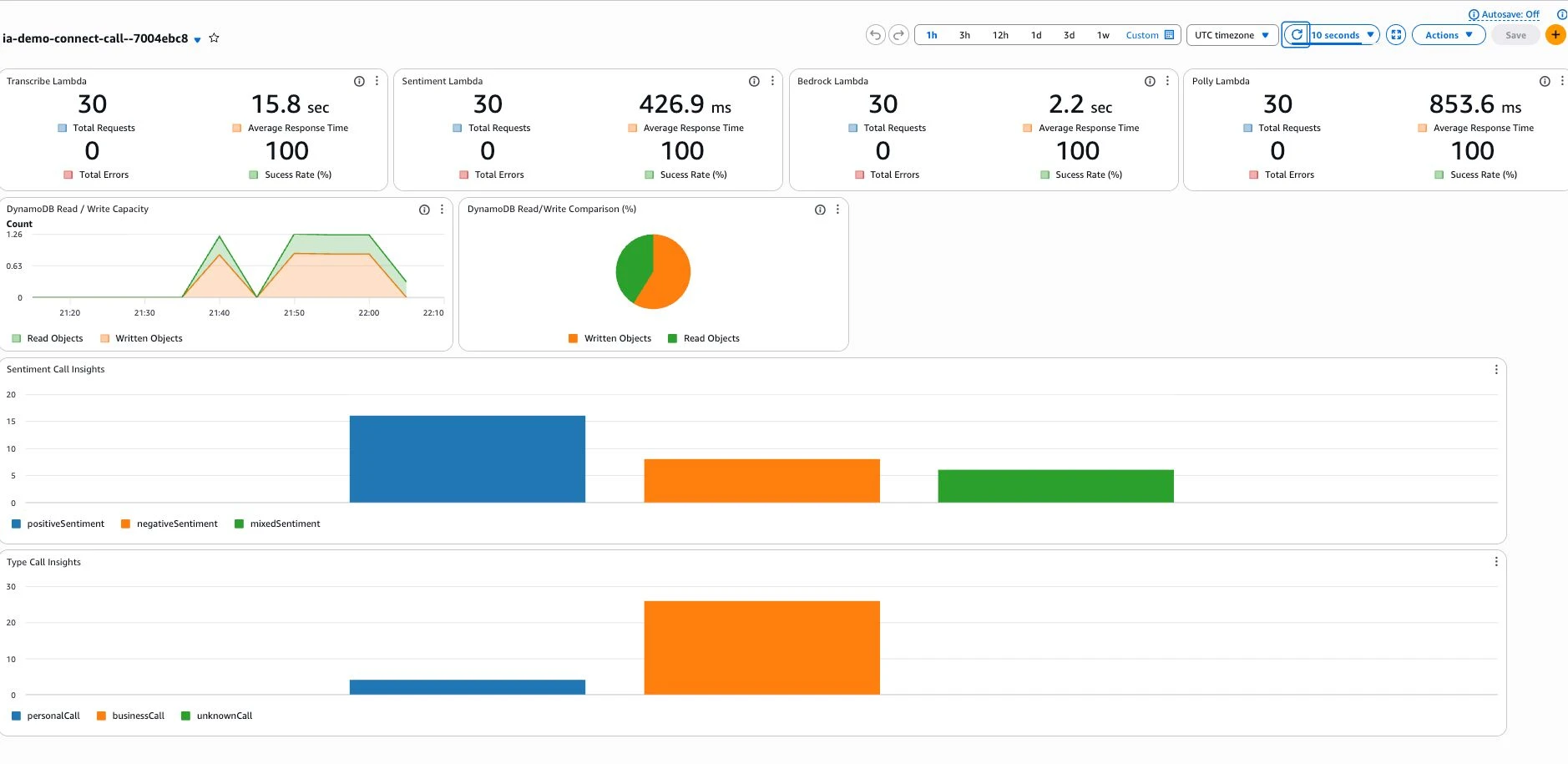
In the dashboard above, there are both infrastructure and business metrics. For the infrastructure metrics, we first have AWS Lambdas. Each Lambda pane has invocation counts, average response time, error counts, and percentage success rates. These are important metrics as we can control not only outliers, but also potential improvements in timing and billing, as Lambdas are billed per second. Secondly, we have Amazon DynamoDB, covering read and write capacity units across multiple representations; Both give infrastructure teams the visibility needed to make informed scalability decisions and optimize solution performance.
For the Business metrics, we first have the detected sentiment from Amazon Comprehend as a metric. The goal of this metric is to serve as a potential KPI, enabling senior leadership to take preventive or corrective actions based on sentiment in client calls. Call type classification is also included, as only business calls are ideally admitted in the Call Flow.
To persist the results, the solution uses a DynamoDB table. This way, we stay within the Serverless paradigm and retain the flexibility to add, remove, or modify fields.
With the individual components defined, the next step is orchestration. AWS Step Functions is an ideal service for this purpose, providing a centralized workflow that coordinates each stage of the processing pipeline. Step Functions operates as a state machine, with a clear beginning and end, and with the ability to branch into different paths based on the inputs and outputs of each state.
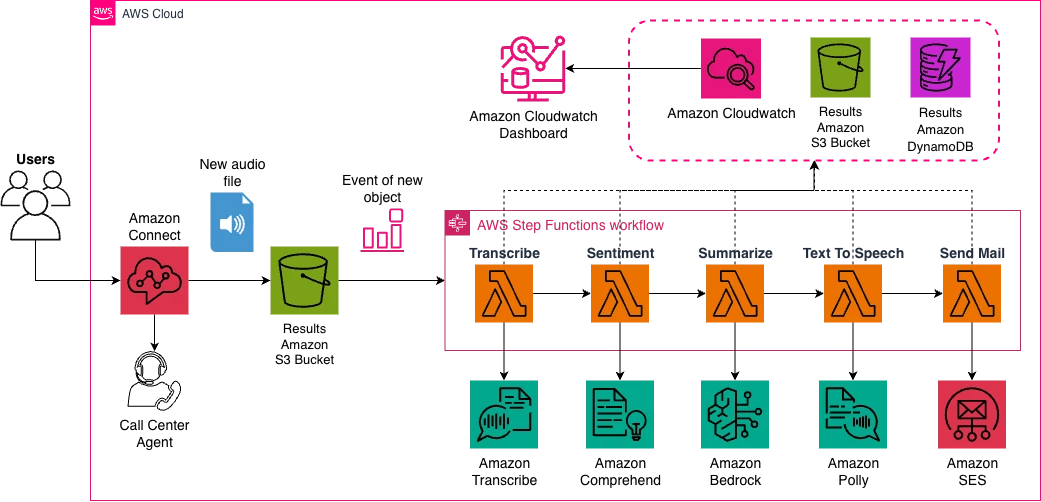
In this architecture diagram we can see how each element is wired up, starting with a user initiating a call to Amazon Connect and making the recording available in an S3 bucket.
When that object is available in the S3 bucket, an Amazon Eventbridge rule fires the AWS Step Function state machine which will process the audio, generate the different AI assets and send the sentiment, call type, summary, recommendations, and artifact locations via SES to the designated recipients.
All AWS Lambda functions under the hood of the AWS Step Function state machine send enriched and custom signals to CloudWatch to feed the Dashboard. That dashboard can be used to make decisions based on data and measurements.
The difference between a call center that only records calls and one that leverages them comes down to automated analysis. With this event-driven architecture, every customer interaction becomes an opportunity for improvement.
AWS Step Functions coordinates the complete flow: transcription, sentiment analysis, insight generation, and automatic notifications. Quality managers receive real-time alerts about problematic calls, while CloudWatch dashboards reveal trends that would otherwise go unnoticed.
The result is more than just information. It's action. Every analyzed call is an opportunity to improve, train agents more effectively, and elevate service quality.
At Caylent, we help organizations move beyond simply collecting customer interaction data and turn it into actionable insights that drive measurable improvements. Whether you're modernizing an existing contact center, building AI-powered workflows on Amazon Connect, or designing event-driven architectures with services like AWS Step Functions, Amazon Bedrock, and Amazon Transcribe, our team can help you accelerate implementation while ensuring scalability, observability, and operational excellence. From strategy and architecture to deployment and optimization, Caylent helps organizations transform every customer interaction into an opportunity to improve service quality, agent performance, and business outcomes. Reach out to us today to get started.

Edwin is a Cloud Architect at Caylent, an AWS Community Builder, and an AWS User Group Leader in Mexico City. He specializes in modern cloud architectures, helping organizations build scalable and reliable solutions using serverless, generative AI, automation, DevOps, observability, and event-driven architectures. As an active AWS community leader, he regularly speaks at AWS User Group Meetups, Community Days, AWS Summits, and worldwide conferences, where he shares practical engineering practices and real-world cloud solutions. He is passionate about building technology that empowers developers and simplifies complex cloud challenges.
View Edwin's articles
Luis Guerra is a Principal Cloud Architect at Caylent, where he oversees client engagements by providing best practices, technical guidance, and hands-on development alongside engineering teams. An active member of the AWS community in Mexico, Luis regularly speaks at User Group Meetups and Community Days. Passionate about AWS and cloud architecture, his philosophy centers on leveraging technology to make people's lives easier. Outside of work, he serves as a Karate coach and enjoys golf.
View Luis's articles