
Caylent Services
Data Modernization & Analytics
From implementing data lakes and migrating off commercial databases to optimizing data flows between systems, turn your data into insights with AWS cloud native data services.

Caylent partnered with Ajax Analytics to build a first-of-its-kind platform that unifies complex environmental sensor data into a clean, scalable, and actionable system. In just 8 weeks, we delivered datapoint connectors, auto-scaling endpoints, a multi-source data warehouse, and a modern frontend—complete with monitoring and alerts to support long-term growth. The platform launched now powers easy-to-use insights for researchers, citizens, and regulators across Colorado, including the City of Broomfield and the state’s Department of Public Health and Environment.
Ajax Analytics is an environmental monitoring and data analytics company that provides real‑time insights on environmental conditions to support smarter decision‑making and stakeholder communication.
A spin-off from a Colorado State University research program, Ajax secured their first large customer late in 2018. The City and County of Broomfield wanted visibility into air quality and emissions data in the face of urban oil and gas extraction operations. Ajax agreed to take the project on.
In only 2-3 months, Ajax would need to pull together a research-friendly frontend interface for all the device-collected data in their network. As an added layer of complexity, the environmental sensors weren’t uniform—they would be dealing with several different devices and data structures.
“We didn’t want to slap something together that wasn’t scalable; we wanted to invest in a great foundation for a future platform. So we started looking for partners who could build high quality, quickly, using the best available modern technologies.” - Brent Buck, CEO at Ajax Analytics
Their search brought them to Caylent.
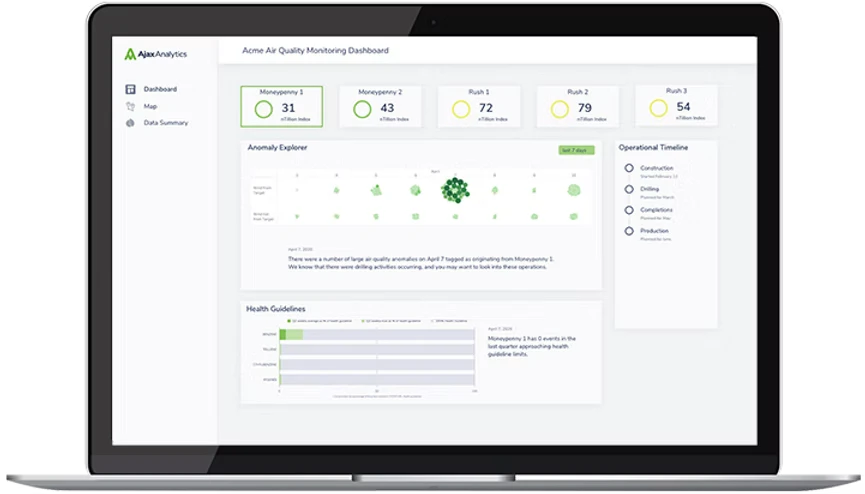
Ajax needed to build a platform that could pull in data from IoT environmental sensors, put it into a canonical format (accounting for a variety of sources and formats), and store it in a series of data lakes.
They knew they were on a short timeline, and they needed a development partner who could work autonomously to get the job done.
“With B- or C-player companies, I’d have to give high-fidelity mockups of the architecture before they’d build it. But Caylent really stepped up to the plate. They designed it and got it done.” - Brent Buck

“There’s a boatload of data out there, but it’s never pulled into a format your average citizen can understand. What Caylent has given us the ability to do is pull data from all these different sources and get it into a system where we can start making sense of data to find the operational changes that provide real ROI toward a cleaner and healthier environment.”
Brent Buck
President and CEO
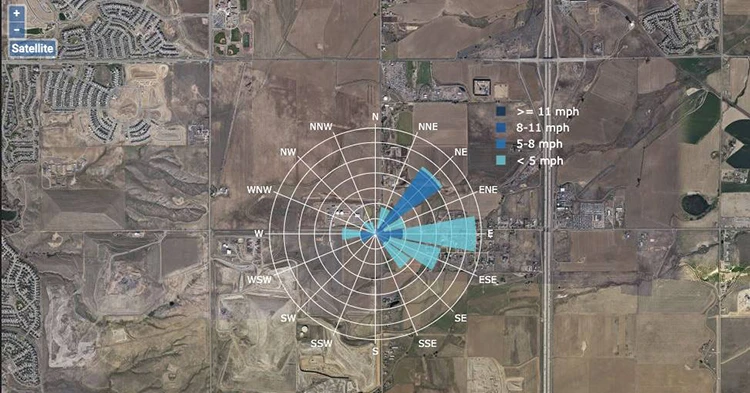
Caylent spent two days onsite with the Ajax team, talking through business needs and the pros and cons of different architecture choices.
They needed to figure out how much data was coming in from each device, how the device would be secured, and how best to establish a connection with the device and AWS.
By the end of the design discussions, they had decided on the following architecture:

They would use AWS IoT Core to connect devices to and send data into AWS. For devices that couldn’t connect directly to the cloud, they would dump their data into a file and send it to AWS via a file upload on Amazon S3. The data processing—mapping dev IDs to customers, and standardizing units—would be done with Amazon Kinesis Firehose and an AWS Lambda function. All the data would be stored in PostgreSQL and accessed via an AWS AppSync API.
For the frontend, Amazon S3 would use the AWS AppSync API to get data from PostgreSQL and render it.
“Caylent cares about what we’re trying to accomplish on a business level. We don’t just talk bits and bytes, we talk about the goals of our business and product to inform every technical decision we make.” - Brent Buck
Caylent had eight weeks to build out datapoint connectors, auto-scaling endpoints, a data warehouse that Ajax could feed with multiple data sources, and wrap it all up in a clean, modern front end.
That was for the bare minimum code base. Caylent also worked to implement monitoring, alerts, and a solid foundation Ajax would need to keep building on the system in the future.
“Caylent did a fantastic job building out the core foundation of our products. I can’t believe how much forethought and effort they put into this.” - Brent Buck
The application went into production on schedule and provided a clean, easy-to-use interface for researchers and citizens. Caylent is still actively working with the Ajax team, planning out new features. In future updates, Ajax wants the app to be able to surface insights from the data using AI and machine learning.
Brent Buck, President and CEO of Ajax Analytics, says that nothing has been done like this for environmental data before, anywhere in the world.
“There’s a boatload of data out there, but it’s never pulled into a format your average citizen can understand. What Caylent has given us the ability to do is pull data from all these different sources and get it into a system where we can start making sense of data to find the operational changes that provide real ROI toward a cleaner and healthier environment.” - Brent Buck
While the solution was first developed for the City and County of Broomfield, the data is now used by the Colorado Department of Public Health and Environment and a number of companies in the industry who want visibility into how they’re doing.
“If we’re going to make critical decisions for our world, we should be doing it based on facts and data.” - Brent Buck