 Peter Sankauskas
Caylent Catalysts™
Generative AI Strategy
Accelerate your generative AI initiatives with ideation sessions for use case prioritization, foundation model selection, and an assessment of your data landscape and organizational readiness.
Explore agentic SDLC as the shift in software development where teams balance AI and human ownership of context and decisions while adapting people, processes, and technology to work effectively with AI agents.
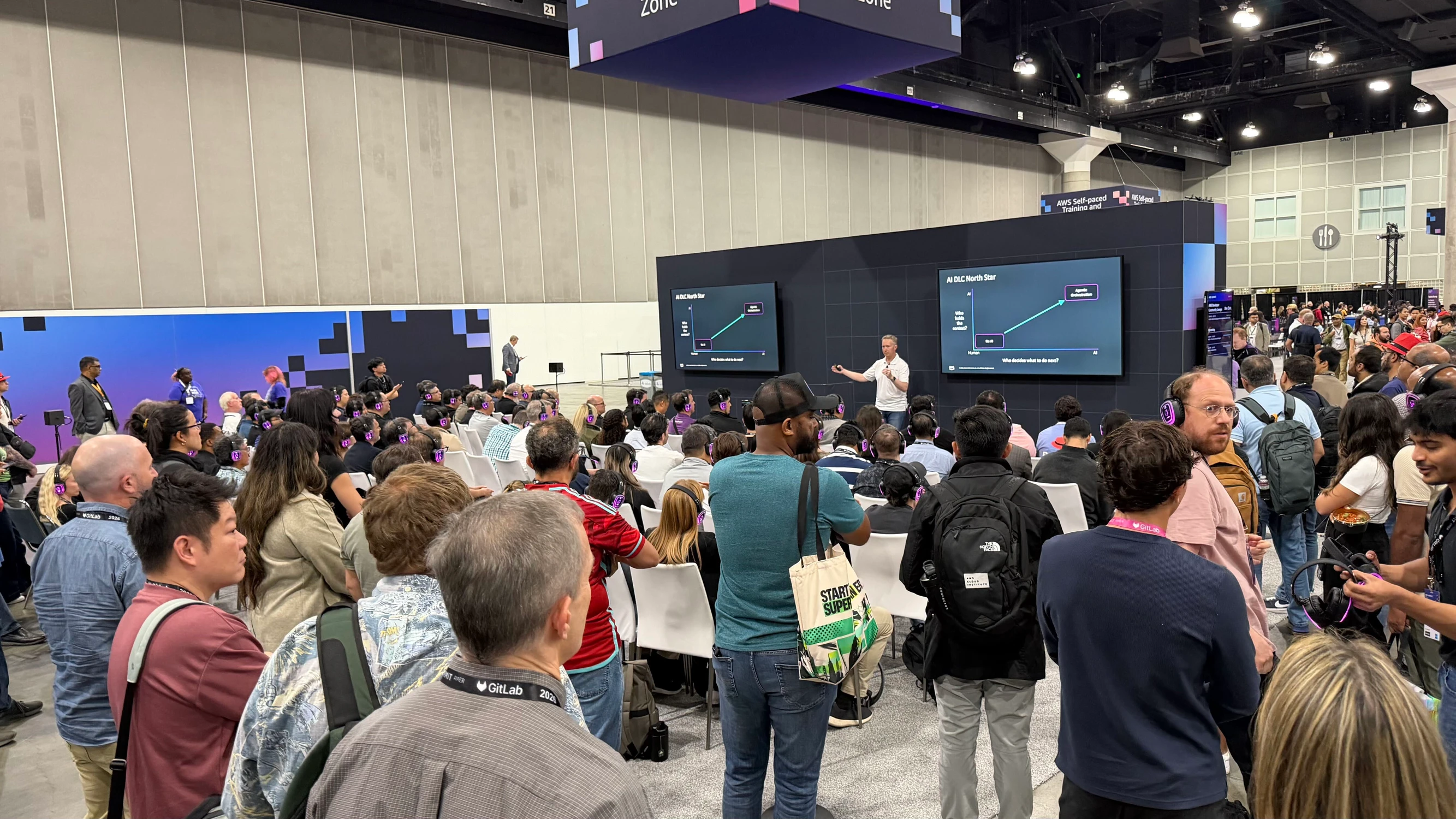
If you work in software today, you are somewhere on the agentic software development lifecycle (SDLC) journey, whether you set out on it deliberately or not. Some teams are still at tab-completion in the IDE. Others already have several agentic workflows running simultaneously and are discovering their CI/CD pipeline is straining, their review queue is overflowing, and their attack surface has tripled.
The landscape is wide, but the central point is simple: where you sit on the trail matters far less than knowing which way you are heading.
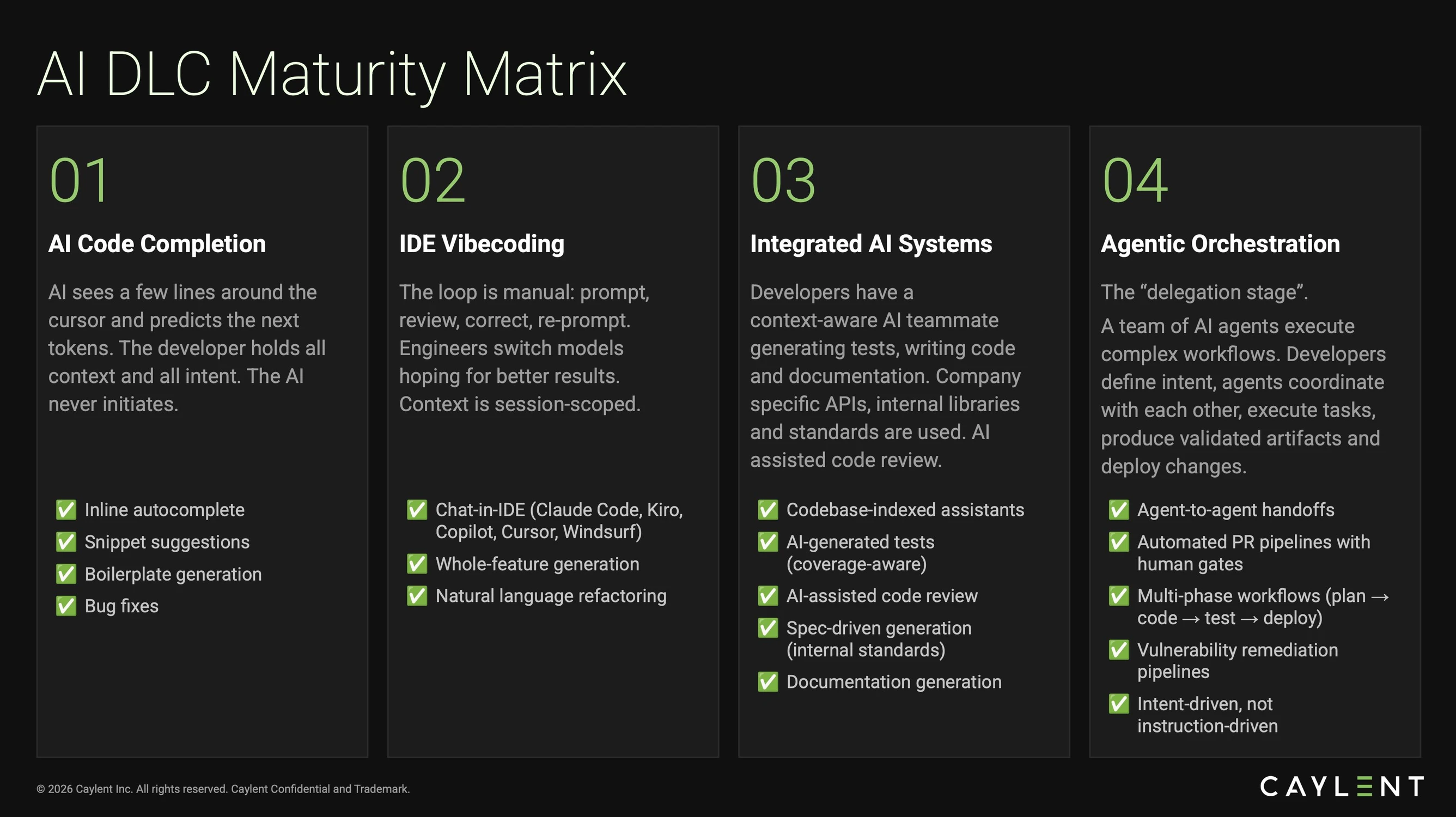
There is no shortage of AI maturity matrices slicing the journey into discrete stages. The challenge, though, is that they are all arbitrary. The number of levels is made up, this one happens to have four. It could just as easily have three, or ten. So how should we be thinking about this? What is the North Star, the single reference point for where everyone is trying to go?
The framework that resonates the most maps the journey onto two questions:
The goal is to shift both from human to AI, together, in a thoughtful and balanced way.
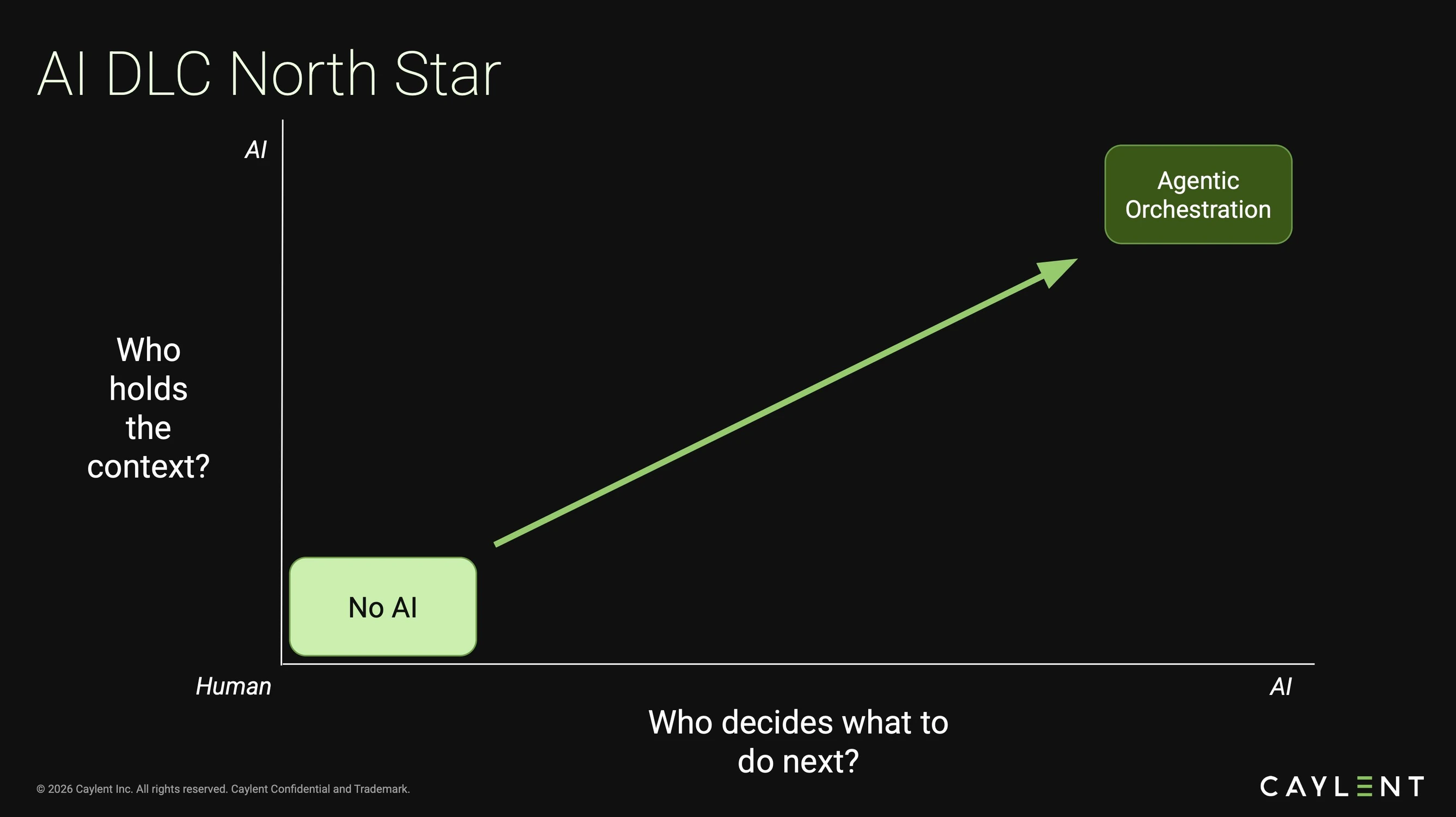
Balance is the whole game. If you give the AI all the context in the world but keep a human approving every single step, you will not have gained any acceleration. If you flip it the other way and hand the AI a lot of autonomy but starve it of context, it will be enthusiastically and confidently wrong. It will solve three problems you never had and miss the one you did. The headlines about teams burning through an entire AI budget in a few months are usually a symptom of exactly this imbalance. Real ROI shows up only when context and decision-making move in step with each other toward the AI.
The second point is that while AI is a technology, adopting it well is not a technology problem. It is an organizational transformation. Like any transformation, it spans three dimensions at once: People, Process, and Technology. A top-down mandate to roll out a new tool touches only one of them, which is why those mandates so often fail. The leaders who get real movement are those who treat all three holistically and bring their team along in waves.
Framing makes or breaks the success of this transformation. Dr Werner Vogels put it well at AWS re:Invent in 2025: "Will AI take my job? Maybe. Will AI make me obsolete? No… if you evolve." A new set of tools means the people using them have to evolve what they do. So when you introduce the transformation to staff, mitigate job-security fears by focusing on how their roles evolve rather than resorting to language about doing more with less, which only signals cuts. Framing should motivate, not frighten.
Interviews across the organization are a good way to learn. They surface what is already working, and just as importantly, the fears people are carrying and the obstacles they keep running into. All of that becomes material for leadership to learn from and to shape training and enablement. Two formats pair beautifully here: office hours where experts field the questions, and a lightweight show-and-tell where someone early in their journey can share a tool or workflow they have just adopted. The show-and-tell gives novices a safe, welcoming place to contribute, and fresh thinking from outside the expert group often yields genuinely innovative ideas the experts would have missed. It is also inspiring to watch peers take their first steps, see what the experts are doing, and absorb a little of it into your own day.
Process has to evolve alongside the tooling, starting with the handoff between Product and Engineering. Product Requirements Documents (PRDs) have always been missing context, because so much of it lived in the engineers' heads and never needed to be written down. An agent does not have that context. So every feature development loop, from Product to Engineering, becomes a feedback signal. You look at what the agents actually produced, the good and the bad, and use that to sharpen what gets written explicitly into PRDs and specs the next time around.
The same discipline applies to the codebase itself. Most AI demos build something brand new from scratch, which makes the whole process look effortless. Real work happens in a complex web of interconnected services. Working there is a lot like cooking: you prepare first. You clean the surfaces, gather the ingredients, and lay out the utensils. For a legacy codebase, that means documenting existing functionality, the libraries in use, and the dependencies between services before agents attempt anything meaningful. Engineering holds this context in their heads. The job is to give the AI a way to build itself up through progressive disclosure and distinct research, planning, and implementation phases.
Test-driven development is a simple way to keep agents honest along the way. Write the failing test first, implement only what makes it pass, and an eager agent has far less room to invent features nobody asked for.
On the technology side, context engineering is the factor to get right. Output quality falls off a cliff once the context window gets too full, and there is no universal threshold for when that happens. Some say 40%, others 60%, and some put it above 100k tokens. The discipline is the same regardless: find where your results start to degrade, then stay out of that "dumb zone" by leaning on sub-agents, progressive disclosure, and compaction.
Where you point all of this first matters just as much. The best early agentic workflows are the unglamorous ones: filling test-coverage gaps, patching vulnerabilities, and clearing tech debt. Code is being created faster than ever, and AI happily amplifies whatever already exists, so the highest-leverage move is usually to clean up before you scale up.
Doing all of this well does not deliver a finish line so much as the next set of problems. CI/CD pipelines that merely strain today become breaking points by the end of the year. Time saved writing code gets consumed reviewing it, sometimes poorly, creating a kind of verification debt. Each agent wants its own isolated environment, and infrastructure starts to sprawl.
This is the journey Caylent helps companies navigate. Having delivered more than 200 GenAI projects to date, we know the trail well. Wherever your company is on the journey, we’ll help you look around corners, stress-test a plan, and accelerate your transformation. Reach out to us today to get started.

Caylent Catalysts™
Accelerate your generative AI initiatives with ideation sessions for use case prioritization, foundation model selection, and an assessment of your data landscape and organizational readiness.
Caylent Catalysts™
Accelerate investment and mitigate risk when developing generative AI solutions.
Leveraging our accelerators and technical experience
Browse GenAI Offerings
Explore what’s new in Claude Haiku 5.5, including what's improved, where Haiku fits alongside the latest Sonnet, Opus, and Fable models, and what has changed in pricing, API behavior, and safeguards.
Explore what’s new in Claude Sonnet 5.5, including its improvements, where it fits alongside other Claude models, and what organizations should know before migrating.
