 Guille Ojeda
 Brian Tarbox
Caylent Catalysts™
Generative AI Strategy
Accelerate your generative AI initiatives with ideation sessions for use case prioritization, foundation model selection, and an assessment of your data landscape and organizational readiness.
Explore Claude Opus 4.7, Anthropic’s most capable generally available model, with stronger agentic coding, high-resolution vision, 1M context, and a migration story that matters almost as much as the benchmark scores.
Anthropic is not moving the frontier tier down-market this time. It’s making the premium tier more useful.
That’s the real story behind Claude Opus 4.7. Pricing stays where Opus 4.6 pricing was, but the model is positioned as meaningfully better at agentic coding, long-horizon autonomy, multimodal reasoning, memory, and enterprise knowledge work. In other words, the headline is not a cheaper frontier model. It’s that the same price card is now supposed to buy more sustained autonomy and better execution on the kinds of workflows that matter in production.
At a spec level, Opus 4.7 is positioned as Anthropic’s most capable generally available model for coding, enterprise workflows, multimodal reasoning, financial analysis, life sciences, cybersecurity, and long-running agentic work. It supports a 1M context window with no long-context pricing premium, up to 128K output tokens, and standard Opus pricing at $5 per million input tokens and $25 per million output tokens. The model's reliable knowledge cutoff is January 2026.
What makes this release interesting is that the product story is broader than “smarter model.” Opus 4.7 is explicitly framed around document work, slide editing, chart and figure analysis, visual verification, file-based memory, and screenshot-heavy workflows. That matters because most real enterprise work is not a benchmark question. It’s reading a slide, checking a chart, editing a contract, keeping track of a multi-day project, or working across a large codebase without losing the thread.
While Opus 4.7 is a strong upgrade, developers must address two breaking API changes before migrating:
temperature, top_p, or top_k is expected to return a 400 error. These parameters must be removed from your request harness, with behavior steering shifted entirely to prompting.thinking={"type": "enabled", "budget_tokens": ...}) are removed and replaced by an adaptive thinking model. Migration requires switching to thinking={"type": "adaptive"} and using output_config={"effort": ...} calibration to control model behavior.If you’re using these parameters a "flip the model ID and move on" migration is not possible.
At a high level, Opus 4.7 looks like Anthropic’s attempt to make the top tier more operationally useful, not just more impressive in a benchmark table. The launch materials emphasize stronger multimodal reasoning, better agentic coding, stronger long-horizon autonomy, and improved memory relative to Opus 4.6.
The benchmark story supports that positioning. The launch deck reports 64.3% on SWE-bench Pro, 87.6% on SWE-bench Verified, 69.4% on Terminal Bench 2, 77.3% on MCP Atlas, 78.0% on OSWorld, and 82.1% on CharXiv without tools / 91.0% with tools. Those are not generic chatbot benchmarks. They line up with the core claim Anthropic is making: Opus 4.7 is supposed to be better at sustained coding, tool use, visual reasoning, and complex task execution over longer traces.
That said, the benchmark table is strong rather than perfect. Opus 4.7 looks especially compelling on coding, tool use, computer use, financial analysis, and visual reasoning, but the materials do not support a clean “best at everything” story. That’s actually the more credible takeaway. The value proposition here is not universal dominance. It’s that Anthropic appears to have moved the premium tier forward on the kinds of long-running, multimodal, agentic workloads enterprises actually pay for.
The most visible raw capability change may be vision. Opus 4.7 introduces high-resolution image support up to 2576px / 3.75MP, up from the previous 1568px / 1.15MP limit. That’s about 3.3x more pixels. The prompt guide also notes that image coordinates now map 1:1 to actual pixels instead of requiring scale-factor math. For screenshot analysis, document parsing, chart reading, computer use, and UI verification, that is a meaningful upgrade.
Anthropic also says the resolution increase alone improved evaluation performance by +2.4 percentage points on InfographicQA and +4.4 points on ScreenSpot Pro. That’s a useful data point because it isolates the impact of the vision pipeline itself rather than bundling it into a broader model-quality story.
The first thing to understand about Opus 4.7 is that list pricing is unchanged from Opus 4.6:
Notably, the 1M context window carries no long-context pricing premium — the same per-token rates apply regardless of how much context you use. That is a meaningful differentiator from providers that charge a premium above 128K or 200K tokens.
Opus 4.7 also delivers faster raw throughput than its predecessor, at roughly 81 tokens per second compared to Opus 4.6's ~72 TPS. However, faster throughput does not automatically mean faster end-to-end task completion, because Opus 4.7 may use more tokens per task depending on the workload.
But that does not mean your cost per task stays flat.
Anthropic’s prompting guidance says Opus 4.7 counts tokens differently than Opus 4.6, and the same input text may produce a higher token count. It also says token efficiency varies by workload shape: Anthropic has observed lower token usage in autonomous workloads and slightly higher token usage in interactive workloads. So the economics of Opus 4.7 are not just a pricing-page question. They’re a workload-profile question.
Let’s run the numbers for some representative scenarios.
Suppose you’re running an internal coding assistant where a typical session includes 8 turns, averaging 3,000 input tokens and 700 output tokens per turn. That’s 24,000 input tokens and 5,600 output tokens per session.
With Opus 4.7:
At 20,000 sessions per month, that’s about $5,200.
The important caveat is that Anthropic explicitly says interactive workloads may use slightly more tokens in 4.7 than equivalent 4.6 workloads, so the right way to read this example is as price-card math, not as a promise that your post-migration bill will be identical.
Now consider a higher-value agentic task: 60,000 input tokens across instructions, retrieved context, and tool traces, plus 18,000 output tokens across thinking and final synthesis.
With Opus 4.7:
At 10,000 tasks per month, that’s about $7,500.
This is where Opus 4.7’s task budget feature becomes strategically important. Instead of only hard-capping a turn with max_tokens, you can give the model visibility into the total token budget for the full agentic loop so it can plan, prioritize, and wrap up more gracefully.
Suppose you’re reviewing 100 dense finance or legal packets against a shared 80,000-token instruction and reference context, then adding 4,000 fresh input tokens and getting 3,000 output tokens per request.
First request:
Subsequent 99 cached requests:
Total for 100 requests: about $13.96.
Without caching, the same 100 requests would cost about $49.50. The pattern is familiar, but still important: once you start reusing large prompts or shared reference corpora, prompt caching becomes one of the cleanest levers for making large-context work viable.
Batch processing matters too. If your workload is asynchronous, the 50% batch discount can materially change the cost curve for large-scale analysis and back-office workflows.
The biggest cost surprise is vision. Anthropic says the higher 2576px image cap can use roughly 3x the image tokens of the previous 1568px cap, and the maximum number of images per request may fall from around 100 to an estimated 40 in a 200K context. Importantly, there is no API parameter to fall back to the legacy 1568px resolution — the only way to control token cost is to downsample images client-side before sending them to the API. The vision gains are real, but they are not free.
Task budgets are one of the most interesting runtime features in the Opus 4.7 materials. They let developers define a token budget for the full agentic loop, including thinking, tool calls, and final output. The model sees a running countdown and uses it to decide how much searching, tool use, and synthesis the task still deserves.
That’s different from max_tokens, which remains a hard ceiling but is not visible to the model.
That distinction matters. A hard cutoff only stops spending after the model has already made bad planning decisions. A visible budget changes behavior earlier in the loop. It gives the model a chance to decide not to launch another exploratory branch, not to keep calling tools indefinitely, and not to burn a large share of the turn on low-value work.
There are limits. Task budgets are advisory rather than enforced, and the minimum total is 20,000 tokens. Be careful with tight budgets: if the budget is too restrictive for the task at hand, the model is likely to refuse the task outright rather than degrade gracefully. This is not a soft quality tradeoff — it can mean getting no useful output at all. They are available via output_config.task_budget and require the beta header anthropic-beta: task-budgets-2026-03-13.
In other words, task budgets are not a magic cost governor. They’re a planning signal. You still need max_tokens as the hard stop.
For long-running agents, the most interesting detail is that budgets can be carried forward across compaction cycles. That makes the feature much more relevant for real agent systems than it would be if it only applied to a single isolated response.
Opus 4.7 is presented as a strong upgrade from Opus 4.6, but it is not a trivial one. Anthropic’s prompt guide explicitly calls out behavioral and API changes worth understanding before you migrate. For teams with mature prompts, tool harnesses, and UX assumptions, that is not background noise. It’s a large part of the story.
Starting with Opus 4.7, setting temperature, top_p, or top_k to any non-default value is expected to return a 400 error. Anthropic’s migration recommendation is to omit them and use prompting to steer behavior instead.
That is a bigger change than it looks, especially for teams that have been relying on temperature=0 as a proxy for determinism.
Extended thinking budgets are removed in Opus 4.7. If you were using:
thinking={"type": "enabled", "budget_tokens": 32000}
the migration path is:
thinking={"type": "adaptive"}
output_config={"effort": "high"}
This is not just a syntax change. It shifts the way you control the model from explicit thinking budgets toward effort calibration and task-level planning.
Thinking blocks still exist, but their text is empty unless you opt in. If you stream reasoning to end users, the new default can look like a long pause before visible output begins. Anthropic’s recommendation is to set thinking display to summarized when you need user-visible reasoning progress.
Because token counting differs from Opus 4.6, Anthropic recommends revisiting max_tokens headroom and compaction triggers. This is especially important if you run long traces, use aggressive context packing, or have production safeguards built around prior token counts.
Anthropic recommends starting at medium and testing from there. High is described as the recommended default for high-intelligence activities and is often the sweet spot on quality, token efficiency, and tool-error rate. Extra-high is a distinct tier, not just "high but more" — it is specifically recommended for tasks that require exploratory behavior, especially repeated tool calling and agentic search. Detailed web search and knowledge-base search are called out as workflows that perform best at extra-high effort to ensure sufficient exploration. Max is reserved for genuinely frontier problems where token usage is secondary.
That guidance is worth taking seriously. The materials explicitly warn that max can materially increase token usage for relatively small quality gains, and on some structured tasks it can overthink its way into worse answers.
If you run Opus 4.7 at max or extra-high, Anthropic recommends a large output token budget so the model has room to think, call tools, and act across subagents. The prompt guide suggests starting around 64K and tuning from there.
If there is one migration takeaway to emphasize, it’s this: re-baseline the harness, not just the prompt. Validate cost, latency, tool-calling frequency, compaction thresholds, reasoning visibility, and output style. Opus 4.7 may be a better model than 4.6, but it also appears more opinionated about how it wants to be used.
One of the clearest themes in the prompt guide is that Opus 4.7 interprets instructions more literally than Opus 4.6, especially at lower effort levels. It will not silently generalize an instruction from one item to another, and it will not infer requests you didn’t make.
That is mostly good news. For API use cases with carefully tuned prompts, structured extraction, and multi-step pipelines, more literal instruction following usually means less thrash and more predictable behavior. The downside is obvious too: weak prompts that Opus 4.6 papered over may now break more visibly. Anthropic notes that some early testers found Opus 4.7 exposed issues in their existing prompts precisely because it followed instructions more faithfully than 4.6 did. A prompt and harness review may be especially useful before migration.
Anthropic also says Opus 4.7 tends to use tools less often than Opus 4.6. That is not automatically a regression. In some systems it will reduce unnecessary tool chatter. But in tool-first products, it means you should be more explicit about when the model is expected to call tools and how aggressively it should do so.
The model also calibrates verbosity more dynamically. Simple lookups tend to get shorter answers; open-ended analysis gets longer ones. That is generally a positive change, but products with a strict voice or fixed response envelope may need prompt work to keep outputs at the right length.
The same goes for tone. Anthropic describes Opus 4.7 as more direct and more opinionated, with less validation-forward phrasing than Opus 4.6. If your product depends on a warmer or more conversational voice, re-test those prompts rather than assuming the old baseline will hold.
Progress updates appear to be better as well. Anthropic explicitly notes that Opus 4.7 gives more regular, higher-quality status updates during long agentic traces. If you’ve added scaffolding like “after every 3 tool calls, summarize progress,” it may be worth removing that scaffolding and re-baselining.
Finally, Opus 4.7 tends to spawn fewer subagents by default. That matters for teams that rely on aggressive fan-out or parallel investigation patterns. Anthropic’s guidance is that this behavior is steerable, but the model will not volunteer as much subagent parallelism unless you tell it when that behavior is desirable.
“Enterprise workflows” is usually vague. In the Opus 4.7 materials, it is more concrete.
Anthropic specifically calls out improved .docx redlining, better .pptx editing and layout self-checking, stronger chart and figure analysis through image-processing libraries, and better file-based memory for agents that maintain notes, scratchpads, or structured memory across turns.
That is a useful distinction. Many enterprise use cases are not really about raw text generation. They are about reading a slide, checking whether the chart axis matches the narration, editing a contract without damaging formatting, or carrying forward project context through a multi-day workstream. Opus 4.7 appears to be designed for that kind of work more explicitly than earlier Claude releases.
The high-resolution vision change reinforces that. Screenshot understanding, document QA, diagram interpretation, coordinate-based workflows, and artifact verification all benefit from more pixels and 1:1 coordinate mapping.
Financial analysis and security work are also core to the positioning. The launch materials frame Opus 4.7 as a strong fit for dense filings, charts, compliance-sensitive analysis, code review, investigation, and long-trace security work.
Life sciences is another area Anthropic highlights. The materials describe gains in analyzing unprocessed sequencing data, structural biology, and chemistry data, along with the ability to sustain context across complex experimental campaigns. For biotech and pharma teams, that positions Opus 4.7 as a research workflow model, not just a general-purpose assistant.
One of the more unusual details in the prompt guide is that Opus 4.7 appears to have a persistent default design taste: warm cream or off-white backgrounds, serif display typography, italic accents, and terracotta or amber highlights.
That sounds cosmetic, but it has real product implications. If you use Opus 4.7 to generate frontend code, slide decks, or visual variants, generic instructions like “clean and minimal” may not be enough to break the default style.
Anthropic recommends two approaches that work better:
That second tactic is especially useful if you previously relied on temperature for design variety. Since non-default sampling parameters now error out, prompt structure has to do more of that work.
Anthropic’s guidance suggests that Opus 4.7 is comfortable taking action. Without explicit instruction, the model may take actions that are difficult to reverse or that affect shared systems, including deleting files, force-pushing, or posting externally.
The recommended mitigation is straightforward: let the model proceed autonomously on local, reversible work, but require confirmation before destructive, shared, or hard-to-reverse actions.
Security teams have an additional caveat. Anthropic says Opus 4.7 ships with enhanced real-time cybersecurity safeguards, and some legitimate pentesting or vulnerability-research workflows may see more refusals. The stated path for vetted organizations is Anthropic's Cyber Verification Program, which reviews applications and returns decisions within approximately two business days — fast enough to be a real option rather than a bureaucratic dead end.
The most interesting architecture pattern here is not to replace every model in your stack with Opus 4.7. It is to use Opus 4.7 where its strengths are actually differentiated: planning, decomposition, ambiguity handling, multimodal synthesis, and final verification.
That suggests a familiar but increasingly compelling pattern: use Opus 4.7 as the planner, reviewer, or document-grounded analyst at the top of the stack, then hand narrower execution work to a cheaper or faster model tier.
A few patterns stand out:
This is where the economics make the most sense. Opus is expensive if you use it for everything. It is much easier to justify when you reserve it for the parts of the workflow that actually need peak intelligence and sustained autonomy.
Choose Opus 4.7 when:
Choose a smaller model when:
For most teams building long-running agents, coding systems, or document-heavy professional workflows, the answer looks like yes.
The capability improvements in the launch materials are meaningful, especially around multimodal reasoning, memory, visual verification, and agentic coding. Anthropic’s own recommendation is to migrate most complex use cases to Opus 4.7.
But this is not a “flip the model ID and move on” migration.
The right migration plan includes:
Teams that do that work should get a materially better model. Teams that skip it may conclude the upgrade is noisy or expensive when the real problem is that their harness was tuned for 4.6 behavior.
For teams migrating from another provider, Anthropic offers two practical shortcuts: an OpenAI-compatible API endpoint (currently in beta) that accepts OpenAI Messages/Completions SDK formats and translates them to Anthropic's native format, and the prompt improver in the Claude Console, which can automatically refine prompts using advanced prompt engineering techniques. Teams already on the Anthropic API can also use the claude-api skill (pre-installed in Claude Code) to help with the migration.
Claude Opus 4.7 looks like Anthropic’s strongest statement yet about what the premium tier is actually for. This is not just a smarter chatbot. It is a model meant to hold context over long stretches, reason across code and images, operate more autonomously, and do higher-quality professional work across documents, slides, charts, and codebases.
The most important thing about Opus 4.7 is not the list price or even the benchmark table. It’s that Anthropic appears to be making runtime control part of the product story. Effort levels matter more. Task budgets matter. Prompt precision matters. Tool instructions matter.
That is good news for teams building serious agentic systems, because those are exactly the knobs you need in production.
Opus 4.7 should be attractive to any organization that has already discovered the limits of “just give the model a prompt and hope for the best.” It offers a higher capability ceiling, but it also rewards teams that treat model behavior, cost controls, and agent architecture as part of the same design problem.
That’s the real upgrade.
As organizations evaluate how to operationalize models like Claude Opus 4.7, the real challenge isn’t just access to a more capable model—it’s designing the right architecture, cost controls, and guardrails to make that capability deliver measurable business value. Caylent helps teams move from experimentation to production by building agentic AI systems that are optimized for unit economics, safety, and real-world execution. From re-architecting model harnesses and optimizing token usage to implementing multi-model strategies and production-grade governance, Caylent ensures organizations can fully leverage advanced models like Opus 4.7 while maintaining performance, reliability, and cost efficiency. Reach out to us today to get started. Learn more at https://caylent.com/anthropic.
Not on the list price. Input and output pricing stay at $5 / MTok and $25 / MTok. But effective cost per task can still move because token counting differs from 4.6, interactive workloads may use slightly more tokens, and high-resolution images consume materially more image tokens.
The big items are sampling and thinking. Non-default temperature, top_p, or top_k values are expected to return 400 errors. Manual thinking budgets are removed. Adaptive thinking becomes the migration path. Thinking text is omitted by default unless you opt into summarized display. And because token counting changes, you should revisit max_tokens headroom and compaction thresholds.
max_tokens?No. Task budgets are advisory planning signals the model can see. max_tokens remains the enforced hard ceiling that the model cannot see.
Usually yes for screenshot-heavy, document-heavy, or coordinate-sensitive workflows. Probably not for simple image classification or lower-fidelity UI tasks where the extra pixels do not change outcomes.
In raw throughput, yes — roughly 81 tokens per second versus ~72 TPS for Opus 4.6. But end-to-end latency depends on the task, because Opus 4.7 may use more tokens to complete a given workload. For latency-sensitive use cases, Sonnet and Haiku remain the better choices.
Opus 4.7's reliable knowledge cutoff is January 2026.
Use Opus when peak intelligence and sustained autonomy are the bottleneck. Use smaller models when speed, cost, or execution volume matter more.
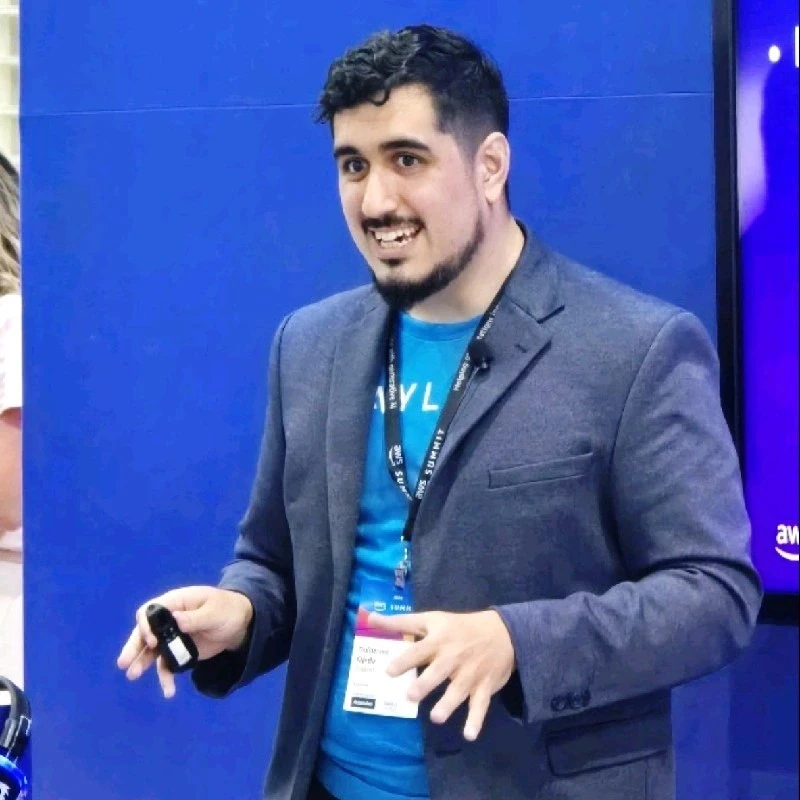
Guille Ojeda is a Principal Innovation Architect at Caylent, a speaker, author, and content creator. He has published 2 books, over 200 blog articles, and writes a free newsletter called Simple AWS with more than 45,000 subscribers. He's spoken at multiple AWS Summits and other events, and was recognized as AWS Builder of the Year in 2025.
View Guille's articles
Brian is an AWS AI Hero, Alexa Champion, has ten US patents and a bunch of certifications, and ran the Boston AWS User Group for 5 years. He's also part of the New Voices mentorship program where Heros teach traditionally underrepresented engineers how to give presentations. He is a private pilot, a rescue scuba diver and got his Masters in Cognitive Psychology working with bottlenosed dolphins.
View Brian's articlesCaylent Catalysts™
Accelerate your generative AI initiatives with ideation sessions for use case prioritization, foundation model selection, and an assessment of your data landscape and organizational readiness.
Caylent Catalysts™
Accelerate investment and mitigate risk when developing generative AI solutions.
Leveraging our accelerators and technical experience
Browse GenAI Offerings
Explore what’s new in Claude Haiku 5.5, including what's improved, where Haiku fits alongside the latest Sonnet, Opus, and Fable models, and what has changed in pricing, API behavior, and safeguards.
Explore what’s new in Claude Sonnet 5.5, including its improvements, where it fits alongside other Claude models, and what organizations should know before migrating.
