

Caylent Catalysts™
Generative AI Knowledge Base
Learn how to improve customer experience and with custom chatbots powered by generative AI.

Insightly, an Unbounce company, partnered with Caylent to build Insightly Copilot, an agentic AI-powered system that replaces traditional UI navigation with intelligent, context-aware interaction. Built on Amazon Bedrock and powered by Claude Haiku 4.5, the system provides secure, multi-tenant, conversational access to complex CRM workflows, paving the way for a fully AI-native sales and marketing platform.
→ Designed and deployed Insightly Copilot, a LangGraph-based generative agent embedded directly in the Insightly UI
→ Transitioned from OpenAI to Claude via Amazon Bedrock for improved governance and flexibility
→ Re-architected backend infrastructure for secure, multi-tenant operation with Postgres row-level isolation
→ Integrated CI/CD pipelines with DeepEval and G-Eval to detect hallucinations and maintain agent quality
→ Implemented persistent agent memory and page-aware interaction for stateful, personalized workflows
→ Replaced complex CRM navigation with conversational, action-oriented interfaces
→ Delivered alpha release of Insightly Copilot in 90 days, enabling rapid beta onboarding and product iteration
→ Established automated evaluation pipelines across 25+ golden queries to enforce deterministic behavior
→ Enabled enterprise-ready deployment via SOC2-aligned authentication and secure tenancy boundaries
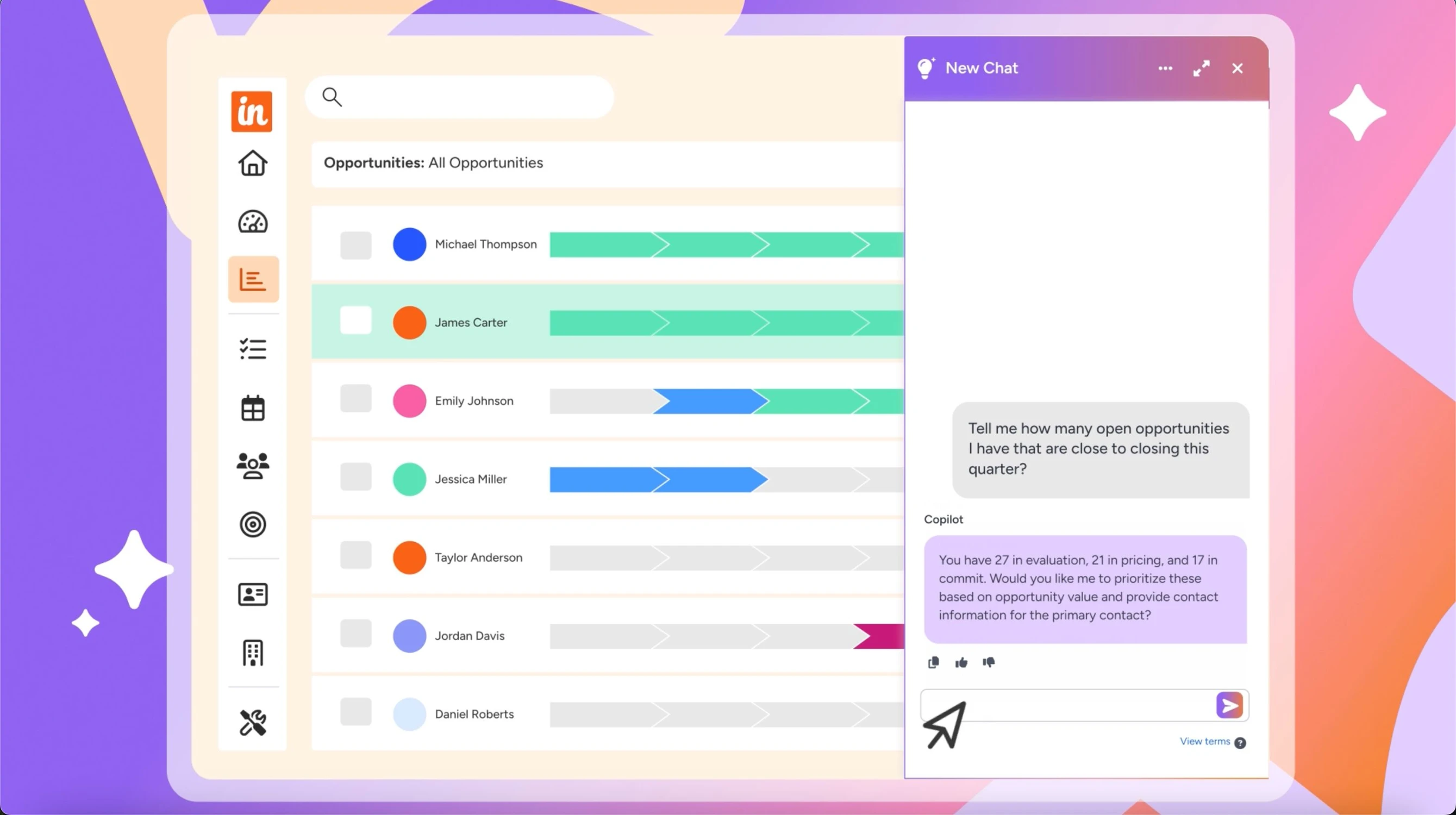
The way we engage with business software is evolving. Rather than clicking through tabs, dropdowns, and dashboards, users increasingly expect to converse with systems, delegating tasks through natural language and receiving intelligent, contextual responses.
Following its recent acquisition by a private equity firm, Unbounce, a digital marketing platform serving over 15,000 customers globally, is accelerating its transformation into a full-stack, AI-powered marketing and sales platform. As part of this evolution, the company acquired Insightly CRM, unlocking a path to unify campaign execution with customer relationship management.
With an ambitious goal to 100x its user base, the organization launched an internal hackathon to explore what an intelligent CRM experience could look like. The outcome was a working prototype of a generative AI copilot. Capable of interpreting plain-language requests and completing complex CRM actions, the POC laid the foundation for a new and intuitive, conversation-first user experience.
To take the copilot from prototype to production, Caylent was selected to design, build, and deploy an enterprise-grade system deeply embedded within the Insightly application. Insightly Copilot serves as a strategic assistant, data analyst, and productivity partner, enabling users to retrieve insights, update records, and execute CRM workflows simply by asking.
Instead of navigating through dashboards or multi-click interfaces, a user might say, “Show me how many deals my team currently has in Commit this quarter",or “Update the status of the Johnson deal to closed-won.” The copilot understands context, manages multi-step execution, and delivers results instantly, transforming how marketing and sales professionals interact with data.
The platform debuted in an alpha release to internal and early external Insightly users, setting the stage for full-scale generative AI capabilities across the ecosystem. Through this partnership, Caylent is helping Insightly redefine the role of CRM in modern marketing, turning operational complexity into strategic clarity with an AI-native interface built for the future.
Within months, the teams delivered:
In addition to building the system’s core intelligence, Caylent delivered the secure infrastructure, observability stack, and evaluation tooling required to support long-term scalability and internal handoff. With this foundation in place, Unbounce is now rapidly advancing toward new capabilities including forecasting, intelligent recommendations, and full natural language workflow automation across its CRM platform.
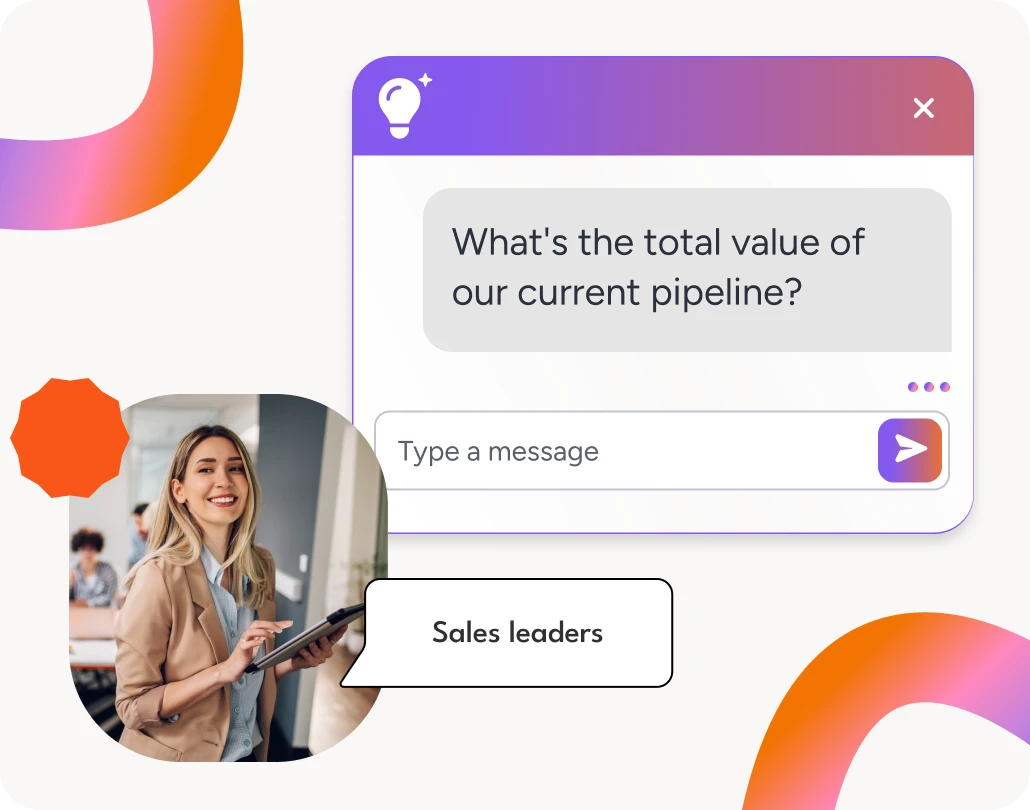
Unbounce's acquisition of Insightly CRM opened the door to building an intelligent assistant interface. To explore this opportunity, they hosted a short internal hackathon and produced a compelling prototype. While the concept validated the potential of conversational CRM workflows, the underlying implementation lacked the scalability, security, and structure required for production use.
To bring Insightly Copilot to life as an enterprise-ready solution, the team needed to:
To transform their prototype into a scalable, production-grade product, the team turned to Caylent as a strategic partner, tasked with helping bring Insightly Copilot to life as a secure, enterprise-ready generative AI solution on a rapid timeline.

“Caylent played a central role in moving our agentic CRM copilot from prototype to production. They worked alongside our team, redesigning the architecture for secure multi-tenant use, embedding the AI natively in the UI, and establishing automated evaluation pipelines for consistent performance. Their leadership was critical to hitting our 90-day launch, managing a smooth migration to Amazon Bedrock, and ensuring the system met enterprise standards. Caylent’s technical depth and collaborative approach raised the bar for our team and the product.”
Mike Cravens
VP of Product

Insightly partnered with Caylent to evolve their internal prototype into a robust, enterprise-grade system powered by Claude in Amazon Bedrock. Rather than simply delivering features, Caylent co-architected the infrastructure, workflows, and interface patterns required to scale Insightly Copilot into a strategic product offering.
Technologies used: LangGraph, Insightly internal APIs, PostgreSQL (checkpointing & memory)
At the heart of Insightly Copilot is an agentic system built using LangGraph, designed to handle real-world CRM workflows through natural language. Caylent redesigned the system to support complex, multi-step operations with built-in memory and decision logic. The agent was also enhanced to include checkpointing and rollback capabilities, enabling human-in-the-loop controls for sensitive actions such as deleting records.
These workflows integrated fully with Insightly’s internal APIs, allowing the agent to perform real tasks like creating contacts, listing open opportunities, and summarizing support activity. This approach laid the groundwork for a CRM experience that feels conversational but remains grounded in reliable backend execution.
Technologies used: React-based Insightly frontend, Native embedding (non-iframe), Page-aware state connectors
To ensure a seamless user experience, Caylent embedded Insightly Copilot directly into the Insightly web application. The chat interface was designed to be page-aware and context-sensitive, so that users interacting with a specific contact or deal record could issue commands relevant to their current view.
Rather than rely on iframes or external interfaces, Insightly Copilot was integrated natively, enabling tight control over behavior and improved performance. This UI architecture also allows for future reuse across other applications or modules within the Unbounce ecosystem, improving extensibility.
Technologies used: PostgreSQL, LangGraph memory nodes
To deliver more personalized and coherent interactions, Caylent implemented a memory layer using PostgreSQL. This gave the agent the ability to retain multi-turn context, remember past actions within a session, and eventually support persistent user profiles. For example, a user can refer back to “the contact I just added” or undo an action with a follow-up message.
These capabilities not only improve user experience, but also enable a more natural interaction flow that aligns with how people think and communicate. This memory system is designed to support long-term roadmap features such as user-level personalization and multi-session thread continuity.
Technologies used: DeepEval, G-Eval, CI/CD pipeline
As the technology evolved, Caylent prioritized maintaining a high standard of quality and reliability. The team implemented a full CI/CD-integrated evaluation framework using DeepEval and G-Eval. This system runs automated tests against a golden dataset of CRM queries curated by the Insightly product team.
Each feature update is scored for correctness, coherence, and hallucination risk, helping the team detect regressions early and ensure consistent performance over time. These evaluations are run continuously as part of the development pipeline, providing both transparency and accountability for agent behavior.
Technologies used: PostgreSQL with row-level security, Custom JWT-based auth with asymmetric encryption
To support Insightly’s growing customer base and enterprise requirements, Caylent implemented a secure, multi-tenant backend architecture. This design uses Postgres row-level security to enforce strict data separation between organizations, teams, and users. JWT-based asymmetric token authentication ensures that all interactions between the frontend and backend are encrypted, verifiable, and isolated.
This architecture allows Insightly Copilot to operate within highly regulated environments while maintaining performance and flexibility. It also supports role-based access control and org-level isolation, enabling Unbounce to serve customers with diverse and complex organizational structures.
Technologies used: AWS CloudFormation, Amazon EKS, Secrets Manager, SSM, CloudWatch, Datadog, MLflow
To support reproducible deployments and internal handoff, Caylent aligned the system architecture with Unbounce’s existing AWS practices. This included the use of AWS CloudFormation for infrastructure-as-code, containerized deployment through Amazon EKS, and secure parameter and secret management via AWS Secrets Manager and SSM.
Observability was handled through Datadog for primary monitoring and CloudWatch for supplemental insights. Caylent also leveraged MLflow for tracking tool trajectories and performance metrics during development. Together, these tools enabled a robust MLOps/LLMOps foundation that supported evaluation, deployment, and long-term scalability. These systems provided full visibility into agent behavior and performance, helping both teams maintain confidence as Insightly Copilot evolved toward production.

Technologies used: Amazon Bedrock, Claude Sonnet 3.5, Claude Haiku 4.5
As part of their strategic roadmap, Unbounce sought to move away from a dependency on OpenAI and transition to a more flexible and compliant foundation. Caylent facilitated a smooth migration to Anthropic Claude via Amazon Bedrock, ensuring compatibility with the existing LangGraph workflows while improving data residency and governance posture.
Unbounce's Claude implementation has evolved through multiple phases, reflecting both the maturation of their use case and the advancement of Anthropic's model capabilities.
In the initial migration phase, Caylent transitioned the system from OpenAI to Claude Sonnet 3.5 via Amazon Bedrock. This migration required careful validation of behavior consistency across CRM workflows, output quality for natural language understanding, and performance tuning for latency-sensitive interactions. Claude's strong instruction-following capabilities and reliable tool use proved particularly valuable for the complex, multi-step CRM workflows central to Insightly Copilot.
As the system matured into production optimization, the team upgraded to Claude Haiku 4.5 for all agent functions. This decision was driven by superior performance characteristics for their specific CRM use case, optimized latency for real-time conversational interactions, and improved cost-efficiency at scale while maintaining quality. The Amazon Bedrock architecture enabled this model evolution without requiring architectural changes and validated the long-term flexibility that guided the original platform decision.
The selection of Claude models was driven by several key factors that aligned with Unbounce's enterprise requirements. Claude Haiku 4.5 via Amazon Bedrock provided improved data residency controls and governance posture compared to direct API integrations with other providers. The managed foundation aligned seamlessly with Unbounce's existing AWS infrastructure and SOC2 compliance requirements. Most critically, Claude demonstrated strong performance for the complex, multi-step CRM workflows that define Insightly Copilot. This transition was handled with minimal disruption to ongoing development, with Caylent managing the validation of behavior, output consistency, and performance tuning throughout the migration process.
For end users, Insightly Copilot transforms complex CRM navigation into simple conversational requests, providing instant and contextual responses that understand intent and enable natural workflow automation, all without requiring users to learn new interfaces. For operations teams, automated evaluation pipelines enforce consistent agent quality, while SOC2-aligned authentication and secure tenancy boundaries ensure enterprise readiness. The multi-tenant architecture positions Insightly for rapid customer growth, and Caylent's full knowledge transfer means the team can now maintain and evolve the system independently, ensuring long-term ownership of this strategic capability.
With the foundation in place, Insightly is advancing toward:
Caylent Catalysts™
Learn how to improve customer experience and with custom chatbots powered by generative AI.
Caylent Services
Apply artificial intelligence (AI) to your data to automate business processes and predict outcomes. Gain a competitive edge in your industry and make more informed decisions.