 Ryan Gross
 Brian Tarbox
Caylent Catalysts™
AWS Generative AI Proof of Value
Accelerate investment and mitigate risk when developing generative AI solutions.
Explore major advancements across the agentic AI stack announced during Swami Sivasubramanian's AWS re:Invent 2025 keynote—from updates to Amazon Bedrock, Kiro, and Strands Agents, to expanded fine-tuning options and powerful identity and memory capabilities within AgentCore.
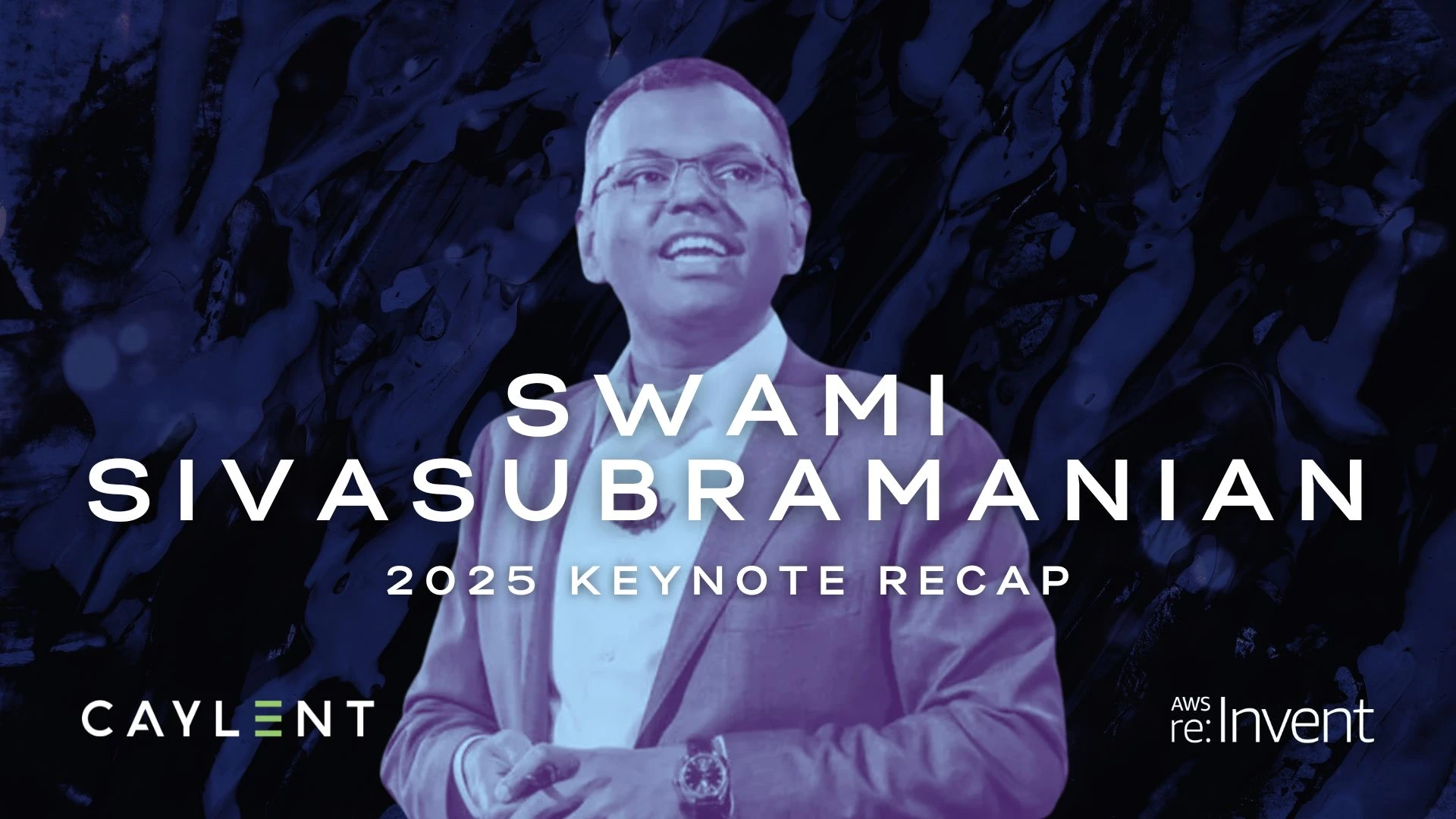
AI innovation is moving at a pace that would have felt impossible just a few years ago. In Swami Sivasubramanian’s AWS re:Invent keynote, one message came through clearly: the distance between an idea and real-world impact is shrinking fast. What used to take years to design, test, and deploy now happens in months, sometimes weeks.
But this shift isn’t just about new models or flashy announcements. It’s about the foundations that make agentic systems reliable, scalable, and practical for real businesses. Swami’s keynote focused on how AWS is building the infrastructure, tooling, and guardrails that allow organizations to move from experimentation to production with confidence.
In past years, AWS re:Invent was often where entirely new services were unveiled. This year, the story looked different. Many of the most important building blocks for agentic AI — including Strands SDK, Amazon Bedrock AgentCore, and Kiro — were released earlier in the year. At AWS re:Invent, the focus shifted to refining and expanding those capabilities.
That change reflects how quickly AI is evolving. When the technology moves this fast, waiting for an annual conference cycle no longer makes sense. Instead, AWS is delivering updates continuously and using AWS re:Invent to show how those pieces fit together into a cohesive, production-ready stack.
The result is an ecosystem that feels less like a collection of isolated tools and more like a connected platform for building, deploying, and operating intelligent systems at scale.
One of the most valuable takeaways from the keynote was AWS's clear articulation of the full AI lifecycle, from model creation and customization to real-world deployment.
Organizations now have multiple paths depending on their needs, ranging from foundation model training with Amazon Nova Forge for teams that require full control, to fine-tuning in Amazon Bedrock for domain-specific optimizations, and finally, advanced customization in Amazon SageMaker AI, with several tuning approaches available.
This flexibility allows teams to align their technical strategy with their business goals, whether by building proprietary models or adapting existing ones for specialized use cases.
What stood out was the emphasis on optionality. AWS isn’t prescribing a single way to build AI systems. Instead, it’s enabling teams to choose the tools, models, and workflows that best fit their environment, constraints, and ambitions. This is demonstrated by the various options available within Amazon Bedrock AgentCore. Developers can select which subset of options is most helpful to them.
As agentic systems move into enterprise and consumer-scale environments, efficiency becomes just as important as capability. Cost optimization, performance, and data readiness all play a role in determining whether AI solutions can move beyond pilots and into sustained production.
While the keynote focused more on model and agent tooling than on data platforms, it reinforced an important reality. AI systems perform only as well as the foundations beneath them. Robust data pipelines, scalable infrastructure, and thoughtful cost management remain essential.
For organizations planning large-scale deployments, this means treating AI as a full-stack investment rather than just a model selection exercise.
The keynote wasn’t just theoretical. Several real-world examples have shown that agentic systems are already delivering value today.
At Caylent, we’ve been running internal tooling built on Amazon Bedrock AgentCore in production for most of the year. These systems help streamline workflows, surface information faster, and reduce friction across teams.
Blue Origin shared an even more ambitious example. Over 2,700 agents actively support everything from information discovery to highly specialized engineering work. When agents are designed with the right architecture and governance, they can scale far beyond simple chat interfaces and become deeply embedded in complex operational environments.
These examples highlight a broader shift. AI agents are no longer experimental side projects. They’re becoming integral parts of how organizations work.
Two Amazon Bedrock AgentCore capabilities stood out in Swami’s keynote: identity and memory.
Identity enables agents to act on behalf of real users when interacting with tools such as Salesforce or Slack. That means actions can reflect the individual's permissions, context, and accountability of the individual, not just a generic bot identity. This also reinforces the importance of security as more and more control is given to agents.
Memory enables agents to learn over time. As users interact with them, agents build an understanding of preferences, goals, and recurring tasks. This creates more personalized, efficient experiences and reduces the need for repetitive instructions, thereby lowering token counts and costs.
Together, these features move agentic systems toward genuine collaboration rather than merely executing commands.
Another theme that emerged was the importance of openness. With innovation happening across the entire AI landscape, no single provider can move fast enough to deliver every breakthrough internally.
AWS is adopting a marketplace-driven approach, enabling teams to integrate third-party tools and frameworks alongside native services. Vercel’s appearance on stage highlighted how external platforms can complement AWS’s own AI SDKs and infrastructure.
This flexibility gives builders freedom to adopt the best tools available and to evolve their stacks as the ecosystem continues to change.
As agents gain more autonomy, trust becomes the limiting factor. Swami’s keynote emphasized the need for enforceable guardrails that prevent agents from taking unsafe or unintended actions.
Consider a simple example in which an agent can make purchases online without restrictions. That level of freedom introduces obvious risk. By defining strict boundaries, such as blocking financial transactions or preventing changes to production environments, organizations can maintain control while still benefiting from automation.
AWS’s automated reasoning capabilities play a key role here. By embedding policy enforcement and constraint validation into agent workflows, teams can ensure that agents operate within clearly defined limits. This makes it far easier to deploy AI systems in sensitive or regulated environments.
While guardrails should be considered table stakes for agentic systems, breakout sessions at the conference demonstrated that there are still multiple attack vectors that require more defence (see AWS re:Invent 2025 - Red Team vs Blue Team: Securing AI Agents).
Beyond the technology itself, Swami highlighted the power of the AWS community. From Road to AWS re:Invent programs to AWS Heroes and global innovation initiatives, builders around the world are using agents to solve real problems in their own contexts.
This shared momentum matters. When knowledge flows freely across regions, industries, and experience levels, innovation accelerates and best practices evolve faster than any single organization could manage on its own.
One of the most memorable moments of the keynote was Swami’s reflection on early programming experiences, from calculator scripts to today’s AI-powered development workflows. The contrast underscores how much the tools have changed, but also how early we still are in this journey.
Even with today’s powerful capabilities, we’re only beginning to explore what agentic systems can become. The gap between experimentation and transformation continues to narrow, and the next wave of innovation will likely feel just as dramatic as the last.
For organizations looking to move faster with AI in 2026 and beyond, a few priorities stand out:
At Caylent, we help organizations turn these principles into working systems, from designing agentic architectures to deploying secure, scalable AI solutions on AWS. The path from idea to impact has never been shorter. The teams that succeed will be the ones who build with intention, clarity, and the confidence to move quickly without sacrificing trust. Get in touch with our AWS experts to discover how we can help your organization take advantage of these exciting advancements.

Ryan Gross leads Cloud Data/AI/ML delivery at Caylent. Through his 15+ years of experience, Ryan has guided over 50 clients in building tech-driven data and AI cultures across various industries. By identifying technology trends, and leading the development of asset backed consulting offerings to realize value, he builds a growth culture within his team. Ryan is also a frequent conference speaker on emerging data and AI trends.
View Ryan's articles
Brian is an AWS AI Hero, Alexa Champion, has ten US patents and a bunch of certifications, and ran the Boston AWS User Group for 5 years. He's also part of the New Voices mentorship program where Heros teach traditionally underrepresented engineers how to give presentations. He is a private pilot, a rescue scuba diver and got his Masters in Cognitive Psychology working with bottlenosed dolphins.
View Brian's articlesCaylent Catalysts™
Accelerate investment and mitigate risk when developing generative AI solutions.
Caylent Catalysts™
Accelerate your generative AI initiatives with ideation sessions for use case prioritization, foundation model selection, and an assessment of your data landscape and organizational readiness.
Leveraging our accelerators and technical experience
Browse GenAI Offerings
Explore all of the launches and capabilities announced at the 2026 AWS Summit in New York City, including Amazon Bedrock Managed Knowledge Base, AgentCore harness, AWS Context, and AWS Continuum.
AWS will end support for Amazon Pinpoint on October 30, 2026. Learn what's going away and what's surviving, what your migration options are, and how to quickly audit your environment to see your exposure.
Explore all the exciting announcements from Dr. Ruba Borno's partner keynote. From the general availability of AWS Transform compatibility to new AWS Marketplace capabilities, the updates showcased powerful new ways for partners to deliver value.
