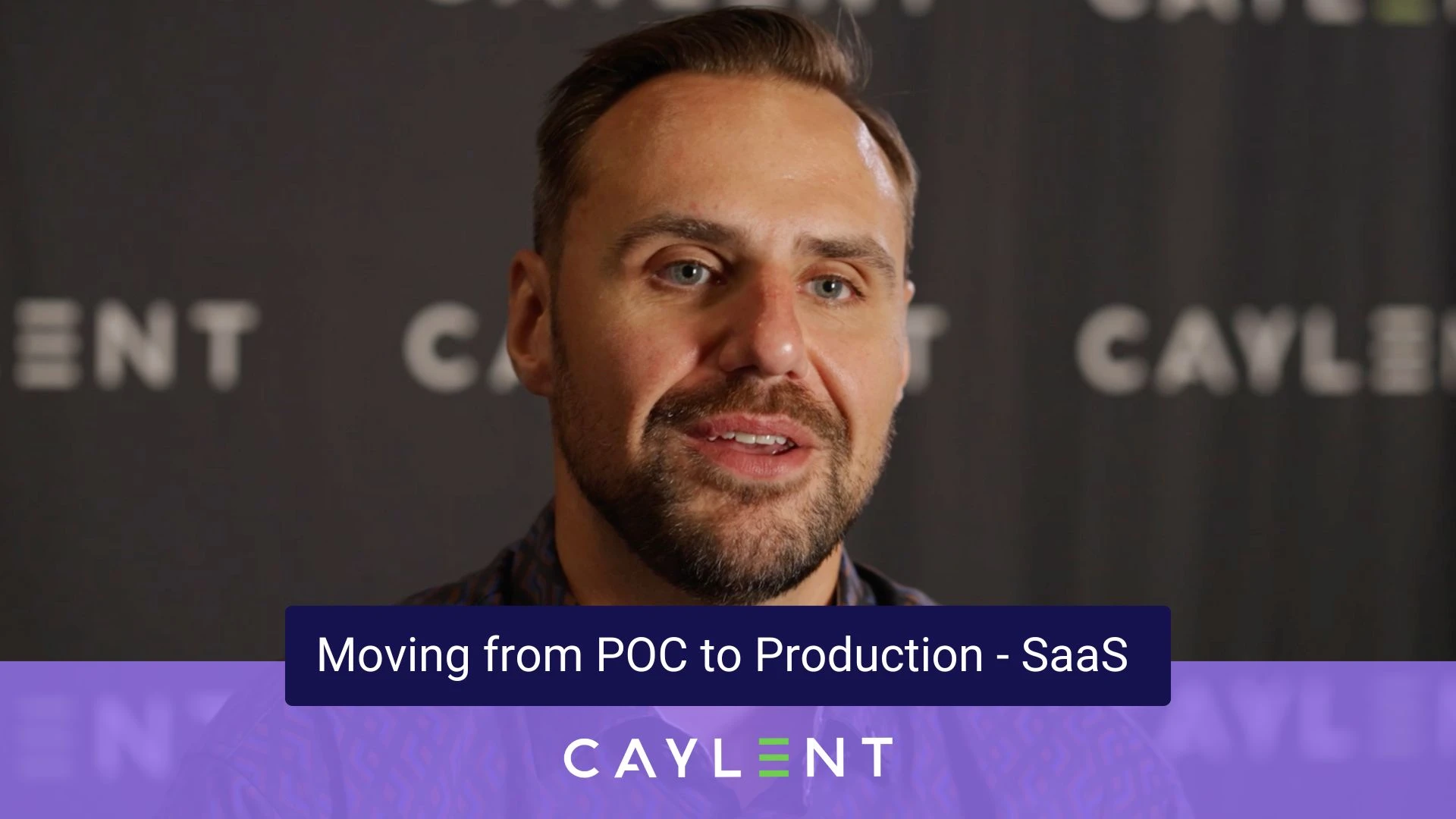
Jason McFadden
Caylent Services
Product Strategy and Experience
Define product direction, design trusted experiences, and deliver AI-enabled products built for adoption, scale, and measurable outcomes.
Learn what becoming a SaaS company requires across product, architecture, go-to-market, support, and culture.
We often work with companies managing software that was never designed for external customers. It usually starts as a tool, something built to solve a real internal problem, until someone eventually asks, “Should we turn this into a product?” That question changes everything. Becoming a SaaS company isn’t just about monetizing code; it’s about rethinking how you build, operate, support, and grow, which will help you become a SaaS company.
This blog will break down what that transformation requires across product, architecture, go-to-market, support, and culture. In this article, we will go over how an organization becomes a SaaS company.
A lot of companies are sitting on genuinely good, internally built software – in essence, tools that were never built to sell. Maybe it started as a contract tracker, a workforce planning system, or a compliance tracker that brought order to audit season. These tools often emerge out of necessity, and often quietly mature into something essential, and then suddenly spark the idea: “We could turn this into a product.”
That moment is where everything shifts. Building software to solve your own problem is one thing; turning it into something other people will adopt, trust, and pay for is something else entirely. It requires a deliberate shift from internal utility to external value, from “it works for us” to “it works for anyone.”
In this scenario, the software wasn’t meant to be a product, just a better alternative to what existed. It replaced guesswork with clarity, cut through the chaos, delivered real answers, and soon became essential to how your team operates. Naturally, someone eventually asks, “If this works for us, why not sell it?”
That’s where the challenge begins. The tool succeeded because your team understood its quirks, workarounds, and limitations. They knew how to avoid the sharp edges and how to fix things when they broke. Your future customers won’t have that context. They expect it to work on day one with no inside knowledge, no unwritten rules, and no one to fill in the blanks when something isn’t obvious.
What you have today is a system shaped by how your company works. If you want to sell it, it has to work for people who weren’t in the room when it was built. And unlike internal users, they won’t ask for help; they’ll simply leave. That’s the difference between software that supports your business and software that is your business.
For most services organizations, the journey into software starts for a simple reason: speed. Teams build internal tools to reduce errors, move faster, and make delivery more predictable. Contract trackers, dispatch systems, client dashboards. None of these were designed as products. They were built simply to withstand growth.
Then something interesting happens. Clients ask for access, colleagues suggest selling it, and demand appears without marketing. Suddenly, you are holding software with a real use case and real pull from the market. This is where many services firms stall, not because the software lacks value, but because the operating model behind it is wrong.
The traits that make services businesses successful are exactly what undermine product scale. Customization, flexibility, and rapid response work when every engagement is bespoke. However, in a product context, they create fragmentation, rising costs, and stalled momentum. Every exception becomes technical debt, and every custom workflow becomes a maintenance burden.
Products require a fundamentally different set of muscles than the ones organizations develop for services. Success comes from sustained focus, not constant flexibility. A product scales when teams make deliberate choices about what the software is and what it is not. That clarity ensures that every new customer strengthens the system rather than fragmenting it. Consistency matters more than customization, as repeatable experiences, predictable behavior, and stable workflows enable users to onboard quickly, trust the product, and adopt it without hand-holding or special exceptions.
This shift also changes who leads the work. Product managers replace project leads because the goal is no longer to deliver a scoped engagement, but to own outcomes over time by balancing customer needs, technical constraints, and long-term business strategy through a shared roadmap. Sales must be enabled with clear positioning, documented value, and repeatable narratives, rather than relying on one-off explanations that only work when the builders are in the room. Pricing follows the same principle. It must be transparent, defensible, and repeatable, so customers can understand what they are buying and why it is priced as it is, without every deal being renegotiated through an RFP.
Underneath all of this, the architecture must be designed to scale as a single system, not duplicated and tailored for each customer, because true product leverage comes from improving one platform that serves many rather than maintaining countless variations that slow teams down and compound technical debt.
The real shift lies in being intentional about who the software is built for. Becoming a SaaS company means deciding to stop tailoring everything to everyone and commit to a clear, repeatable solution that serves many.
Becoming a SaaS business isn’t about putting a price tag on internal software. It’s about building an organization that can support, sell, and scale a product. That means building:
Becoming a SaaS company is ultimately a shift in how you operate, not just what you sell.
That shift becomes even more important when AI enters the picture. Many SaaS teams are exploring AI-driven features, but far fewer are successfully bringing those ideas to market. One example of navigating that gap is Insightly by Unbounce.
The team was developing an AI-powered copilot for their CRM and had already experimented with multiple approaches using OpenAI and other tools. While the concept showed promise, it didn’t yet meet the reliability, performance, and product standards required for a public release. Insightly partnered with Caylent with a clear goal: move from proof of concept to production within 90 days.
Together, the teams not only delivered a production-ready solution, but also ran structured alpha and beta programs to validate the experience with real users. The result was an AI copilot that met customer expectations, aligned with Insightly’s product vision, and was built on a foundation that could scale. It’s a strong example of how the right strategy, architecture, and execution can turn experimentation into a real, market-ready product.
This transition isn’t just a strategy but a reset in how you fund, build, operate, and prioritize. Start with the fundamentals:
Making the shift to a true SaaS business is a meaningful transformation, and you don’t have to do it alone. Many companies reach the point where the vision is clear, the software has potential, but the path forward requires new architecture, new processes, and new product muscle. At Caylent, we work with companies sitting on valuable internal software and help them turn it into scalable, sellable products. That often includes:
We’ve helped services firms spin out SaaS ventures, internal tools grow into market-ready products, and leaders move from “We could sell this” to “We’re a SaaS company now.” If you’re serious about making that shift, reach out to us today. We’ll help you build both the product and the company required to support it.

Jason McFadden is Principal Strategist, ISV & SaaS at Caylent. He helps SaaS leaders scale with clarity, speed, and confidence, bridging the strategist’s view with the operator’s urgency to turn AI, cloud, and product strategy into shipped work and measurable results. He scaled Book4Time to $2.5B in annual transactions, co-founded Avail, served as Entrepreneur in Residence at Platform Calgary, and holds the AWS Certified AI Practitioner credential. A 15-time keynote speaker, he has delivered talks at SaaS North, Collision, Elevate, Mesh, and other major stages. His talks show how AI and cloud are reshaping the way companies build, compete, and scale and how leaders can turn that shift into value that lasts.
View Jason's articles
AWS will end support for Amazon Pinpoint on October 30, 2026. Learn what's going away and what's surviving, what your migration options are, and how to quickly audit your environment to see your exposure.
Chatbots aren’t the only way to surface AI, and often, they’re the wrong choice. Discover intelligent interface patterns that drive AI adoption, build user trust, and deliver measurable ROI without forcing users to craft the perfect prompt.
Learn why 85% of AI projects fail and how strategic UX design drives trust, adoption, and measurable ROI.